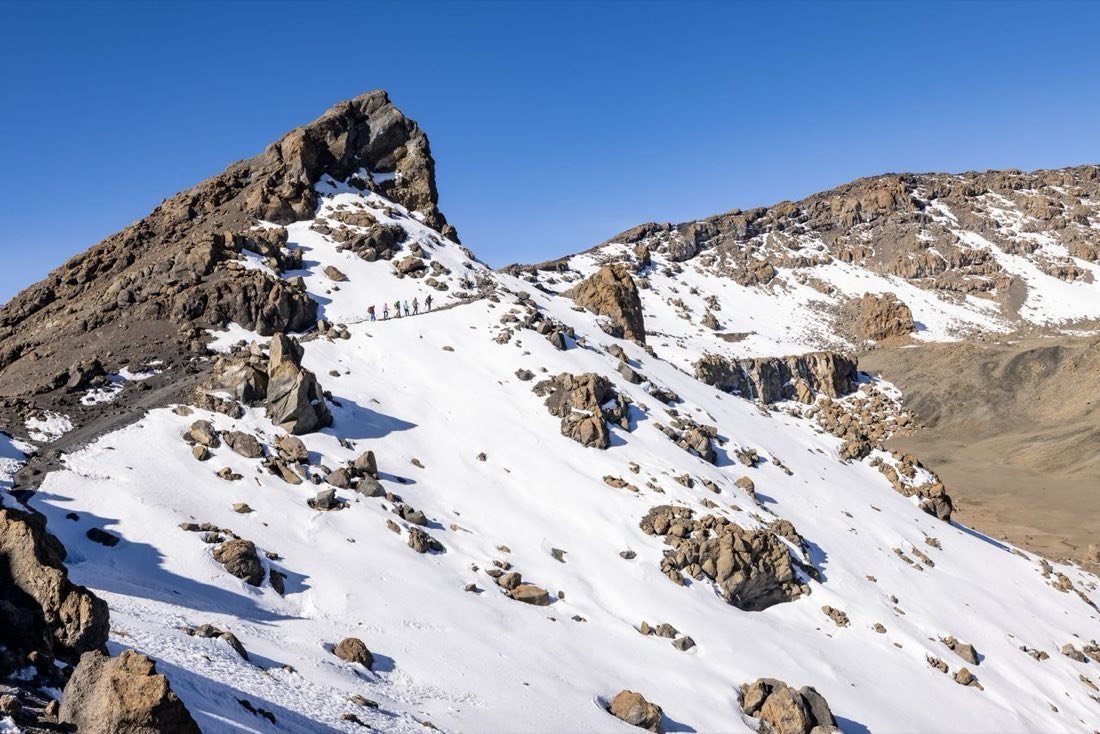
Altitude, not fitness or technical skill, decides who reaches Uhuru Peak. Kilimanjaro rises to 5,895 m, there is no roping or ice work on any standard route, and yet roughly a third of climbers on shorter itineraries turn back. This guide covers what altitude illness actually is, how guides monitor it, what summit night involves hour by hour, and when you will be told to go down. For route choice, start with our Kilimanjaro trekking guide and the routes comparison.
The Three Altitude Illnesses
Acute Mountain Sickness (AMS) is the common one. Symptoms usually appear 6 to 12 hours after a gain in sleeping altitude: headache plus at least one of nausea, loss of appetite, dizziness, fatigue or poor sleep. Mild AMS is expected on Kilimanjaro. It becomes a problem when it worsens despite rest, fluids and a simple painkiller, or when a headache survives ibuprofen or paracetamol.
High Altitude Cerebral Edema (HACE) is brain swelling. Warning signs are loss of coordination (a climber who cannot walk a straight line heel to toe), confusion, unusual irritability, drowsiness and hallucinations. It can progress from AMS in hours.
High Altitude Pulmonary Edema (HAPE) is fluid in the lungs. Look for breathlessness at rest, a persistent wet cough, pink or frothy sputum, a racing heart and blue lips. It tends to show up on the second night at a new altitude.
HACE and HAPE are medical emergencies. The treatment is the same: descend immediately, with oxygen if available, and evacuate. Guides do not negotiate on this. The US CDC’s high-altitude travel guidance sets out the same rules used on the mountain.
Why Shorter Routes Have Lower Summit Rates
Doctors advise that above about 3,000 m you should raise your sleeping altitude by no more than 300 to 500 m a day. Kilimanjaro’s itineraries bend that rule, and the number of days is what decides how badly. As a rough guide, operators report summit success of about 65% overall, with five-day Marangu climbs near or below that, six-day plans somewhat higher and eight-day Lemosho treks often above 90%. These are operator-reported figures, not official statistics, and they vary by season and by client mix.
The reasons are physiological. Extra days at 3,500 to 4,000 m let your body raise red blood cell count and breathing drive before the push to 4,600 m and above. Routes that “climb high, sleep low” help too: on the Machame Route the Lava Tower day (4,630 m) followed by a night at Barranco (3,976 m) is the classic example. The steep Umbwe Route gains height fastest and has the least margin, while Rongai is gentle underfoot but its six-day profile is compressed. Choosing seven or eight days is the single most effective thing you can do.
Diamox (Acetazolamide) on Kilimanjaro
Acetazolamide is the standard preventive drug. A commonly cited regimen is 125 mg twice daily, starting the day before you go above 3,000 m and continuing until you stop climbing. Side effects include tingling in fingers and toes, more frequent urination, and carbonated drinks tasting flat. It is a sulfa-related medicine, so people with a sulfa allergy should not take it.
Please speak to your doctor or a travel clinic before using it. Dosage, allergy checks and interactions are medical decisions, and we are not a substitute. Two points are worth knowing: try it at home first so a side effect is not a surprise at 4,000 m, and remember it helps acclimatisation but does not replace pacing. Do not use it to mask symptoms and keep climbing.
SpO2 and Health Checks
Good operators check every climber twice a day, usually at breakfast and again at dinner, with a fingertip pulse oximeter. The guide records oxygen saturation (SpO2), pulse and symptoms, and asks about headache, appetite, sleep and nausea.
Rough pattern: at 3,000 to 4,000 m, healthy climbers typically read in the high 80s to low 90s. Above 4,600 m, readings in the 70s to low 80s are common and, on their own, not alarming. A single reading means little because cold fingers distort it. Guides watch trends and combine them with how you look and move. A falling saturation plus a rising pulse plus worsening symptoms is the combination that triggers action. Ask your operator before booking how often they test and whether the lead guide has wilderness first aid training.
What Summit Night Actually Involves
Summit night is the hardest 12 to 16 hours of the trek, and it is cold, dark and slow.
- Afternoon rest. You arrive at Barafu Camp (4,673 m) on the Machame, Lemosho and Umbwe routes, at Kibo Hut (4,700 m) on Marangu, or at Kibo on the Rongai route. Eat and try to sleep for a few hours. Few people sleep well.
- Wake-up around 10:30 pm to 11:30 pm. Tea, biscuits, final layering. Water bottles go inside your jacket, since hydration bladder tubes freeze.
- Depart around midnight. Headlamps on, in a single line behind the lead guide at a very slow pace.
- The climb, 6 to 8 hours. From Barafu the path zigzags up scree to Stella Point (5,756 m) on the crater rim, then another 45 to 90 minutes along the rim to Uhuru Peak. You gain about 1,200 m in a few hours. Temperatures run from about -5 to -20°C, colder with wind.
- Summit at sunrise. You spend only 10 to 20 minutes at the top. Staying longer increases the risk of altitude illness and frostbite.
- The descent. Down to Barafu for a short rest and breakfast, then on to Mweka Camp (3,100 m) or Millennium Camp the same day. With the descent included, summit day totals roughly 12 to 16 km and 10 to 15 hours of walking, which makes it one of the longest days on the mountain.
Pace is everything. “Pole pole” means a pace that feels almost embarrassingly slow. A guide who lets you walk faster than you can comfortably talk is setting you up to fail. For clothing, see the summit night layers in the Machame Route guide and our Kilimanjaro costs breakdown for what operators include.
Turnaround Rules and Oxygen
Your lead guide has the final say, and you should agree to that before you start. Standard reasons for turning you around:
- Ataxia (cannot walk a straight line), confusion or slurred speech
- Persistent vomiting or inability to keep fluids down
- Breathlessness at rest, or a wet, bubbling cough
- Severe headache not responding to painkillers
- Falling SpO2 with worsening symptoms
Some climbers fail on summit night simply from exhaustion and cold. That is a legitimate end to the day too. Descending 300 to 500 m often brings rapid improvement in AMS, which is itself diagnostic.
Supplementary oxygen is not for routine use. Operators that carry it keep it for treating a casualty on the way down, and it is not meant to help a struggling climber reach the summit. Confirm the operator’s policy in writing, including who pays if oxygen is used.
Insurance: Check the Altitude Limit
This is the most overlooked step. Uhuru Peak is 5,895 m, and many ordinary policies cap trekking cover at 3,000 to 4,000 m or exclude “mountaineering” entirely. You need a policy that explicitly covers trekking to 6,000 m without ropes or technical equipment, and includes emergency medical evacuation and helicopter rescue. Read the exclusions, not the headline, and keep the policy document on your phone. You can compare options through Tanzania travel insurance and read our Tanzania travel insurance guide. Vaccines and malaria prophylaxis are covered in the Tanzania vaccinations guide. The official park rules are published by TANAPA.
Where to Stay Before the Climb
Most Kilimanjaro operators pick you up from a Moshi or Arusha hotel, and a proper night’s sleep and a hot shower the evening before the briefing helps the first day go smoothly. Moshi is the usual base for Machame, Marangu and Umbwe departures, and Arusha for Lemosho, Rongai and Northern Circuit. We list the three below because each has a live Booking.com listing. We have not stayed in them, so check recent reviews and confirm that the operator can collect you from the hotel.
- Keys Hotel is a 3-star hotel on Uru Road in Moshi town, with air-conditioned rooms, a restaurant and free parking. Convenient for the operator briefing and for buying last-minute gear in town. Do not confuse it with the separate Keys Hotel Mbokomu branch.
- Kibo Palace Hotel is a Moshi hotel that suits climbers who want a more comfortable room for the night before and after the trek.
- Aishi Machame Hotel sits in the Machame area on the mountain’s lower slopes, with a pool and restaurant, which makes it a quiet option before a Machame Gate start. It is further from Moshi town, so factor in the drive.
Booking.com’s Moshi page puts 3-star hotels at roughly USD 75 per night and 4-star at roughly USD 105 as of 2026, with basic guesthouses well below that. Send readers to Moshi hotels for current rates, or see our Moshi accommodation guide. Book a night on each side of the climb: the post-trek shower and bed are worth it, and the flexibility covers a day lost to weather or a late descent. Store any spare luggage at the hotel, which most hotels do for climbers.
Practical Ways to Improve Your Odds
- Take 7 or 8 days. It matters more than any other choice.
- Drink 3 to 4 litres a day and eat even when appetite fades.
- Spend a night at altitude first. A night at Mount Meru’s base or a Mount Meru climb beforehand helps. See also our 3-day acclimatisation itinerary.
- Avoid alcohol before and during the climb, and be honest with your guide about symptoms.
- Pick an operator with ethical porter treatment, an oximeter and a stated oxygen policy. Browse vetted Kilimanjaro treks and compare how many acclimatisation days each one includes.
Prices and success rates change by season and operator, so treat the figures here as approximate and as of 2026.