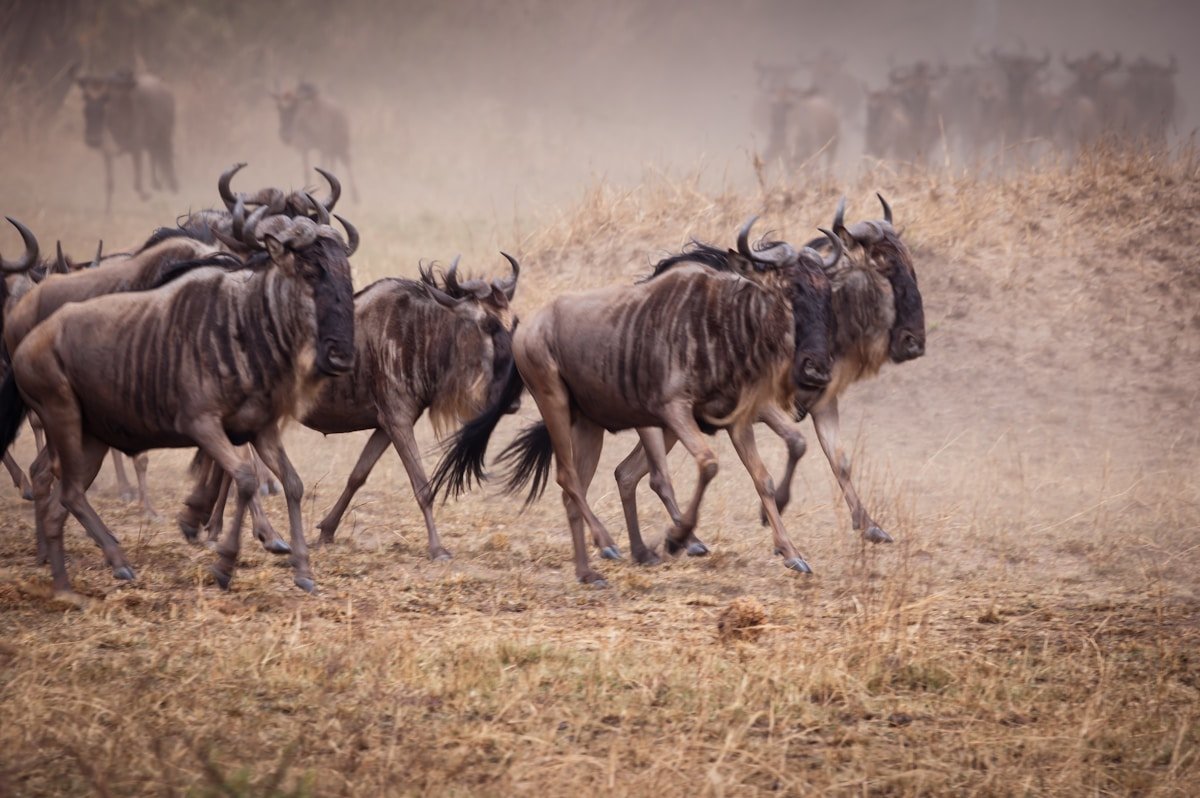
The Serengeti and the Masai Mara are the two most famous wildlife parks in Africa and together they host the Great Migration — the annual movement of roughly 1.5 million wildebeest and 250,000 zebra in a circuit across the Kenya-Tanzania border. Both parks make a serious claim on any serious East Africa itinerary, but they are genuinely different experiences: different in size, in price, in rules, and in the specific moments they are best positioned to deliver.
We are based in Tanzania, so we have a natural bias toward the Serengeti. We have tried to write this comparison honestly.
Scale and Landscape
The Serengeti National Park covers 14,763 square kilometres of open savannah, acacia woodland, kopje-dotted granite outcrops, and riverine forest corridors. It takes three to four hours by road to cross from the Naabi Hill Gate in the south to the Kogatende crossing in the north, and the landscape shifts meaningfully as you move through different ecological zones.
The Masai Mara National Reserve covers 1,510 square kilometres — approximately one-tenth the Serengeti’s area. It shares an unfenced border with the Serengeti to the south, and the two form a single ecosystem across the Kenya-Tanzania border. The Mara is rolling open grassland dotted with acacia, more uniform in landscape than the Serengeti but intensely rich in wildlife.
Around the Masai Mara national reserve sit the private conservancies: Ol Kinyei (about 9,000 acres), Olare Motorogi (about 33,000 acres), Mara North (about 74,000 acres), and Mara Naboisho (about 50,000 acres), among others. These private leased lands, operated in partnership with Maasai landowners, function as buffer zones and overflow habitat for the migration. They are a feature unique to Kenya — nothing equivalent exists on the Tanzanian side of the ecosystem.
Winner on scale and landscape variety: Serengeti, by a significant margin.
The Migration Calendar: Which Park Wins by Month
The migration does not pick a side. The herds follow rainfall and grass, moving in a rough clockwise circuit. Understanding which park to be in at which time is the single most important planning decision for a Great Migration safari.
| Month | Where the Herds Are | Best Park |
|---|---|---|
| December to March | Southern Serengeti / Ndutu (Tanzania) | Serengeti (calving) |
| April to May | Western Corridor, Serengeti (Tanzania) | Serengeti (green season, fewer tourists) |
| June to early July | Central and northern Serengeti | Serengeti (herd consolidation, first crossings) |
| July to August | Northern Serengeti / Masai Mara (both) | Both — Tanzanian side active first |
| August to October | Masai Mara (Kenya) / Northern Serengeti | Both — Kenyan side at peak |
| November | Serengeti, returning south | Serengeti (return migration) |
The calving season (December to March) is Tanzania’s exclusive advantage. The Ndutu area of the southern Serengeti, where roughly 500,000 calves are born within a few concentrated weeks, draws the highest predator density in Africa — lion, cheetah, leopard, spotted hyena, and wild dog all concentrate on the vulnerable newborns. There is no equivalent experience in Kenya.
The Mara River crossings peak from August to October on the Kenyan side. The sight of thousands of wildebeest plunging simultaneously into crocodile-filled water is the single most iconic wildlife spectacle in Africa, and the Masai Mara’s compact geography means you can position and wait at known crossing points for multiple crossings in a single day. The Serengeti’s Kogatende sector sees crossings from late June through August, often with fewer vehicles present.
Winner for calving season: Serengeti (Tanzania only). Winner for peak river crossings: Masai Mara (Kenya) by a small margin, due to geography and July-October concentration. Winner for year-round migration access: Serengeti, which sees some phase of the migration at almost any time of year.
Big Cat Density
The Masai Mara is consistently ranked among the top three places in Africa for lion density, and its open short-grass terrain makes cheetah sightings more frequent and more photogenic than almost anywhere else on the continent. Leopard are abundant in the riverine forests along the Mara River and its tributaries.
The Serengeti matches or exceeds the Mara for lion numbers across the full park — the total population is estimated at over 3,000 individuals — but the park’s size means density per square kilometre is lower than the Mara’s compact reserve. In the central Seronera area and the northern corridor during migration season, lion and cheetah density is comparable to the Mara’s best areas.
For leopard, the Serengeti’s Seronera valley — where several habituated leopards are regularly seen — is one of the better places in East Africa for reliable sightings.
Winner on big cat density (per sq km): Masai Mara national reserve. Winner on total big cat numbers: Serengeti (due to size).
Lodge Quality and Cost
Both parks have exceptional lodge options at the luxury end, and both have mid-range camps that represent good value for the experience on offer.
Serengeti lodges and camps:
- Four Seasons Serengeti (Seronera area): from approximately USD 800 per person per night all-inclusive
- Singita Sasakwa and Sabora: from approximately USD 2,000 per person per night; the gold standard of Serengeti accommodation
- &Beyond Klein’s Camp (northern sector, outside park): from approximately USD 700 per person per night; excellent for northern crossings with more flexibility on off-road driving
- Lemala Kuria Hills (northern Serengeti): from approximately USD 600 per person per night; consistently strong for crossing access
- Sayari Camp (northern Serengeti, Asilia Africa): from approximately USD 700 per person per night; one of the best-positioned camps for Kogatende crossings
- Mid-range: Serengeti Serena Safari Lodge, Serengeti Sopa Lodge — approximately USD 250 to USD 400 per person per night
Browse accommodation near the Serengeti to compare tented camps and lodge options across all price tiers.
Masai Mara lodges and camps:
- Angama Mara (above the Oloololo Escarpment): from approximately USD 1,500 per person per night; arguably the most photographed location in the Mara
- Mahali Mzuri (Mara North Conservancy): Richard Branson’s camp; from approximately USD 1,200 per person per night; private conservancy advantages
- Rekero Camp (national reserve, Mara River): from approximately USD 600 per person per night; consistently excellent predator sightings
- Kicheche Mara Camp (Olare Motorogi Conservancy): from approximately USD 800 per person per night; strong conservancy access, limited vehicles
- Mid-range: Mara Serena Safari Lodge, Governors’ Camp — approximately USD 300 to USD 500 per person per night in the national reserve
For the luxury tier, prices are broadly comparable. The key cost difference appears at the private conservancy level: conservancy fees add USD 100 to USD 200 per person per day in Kenya, on top of accommodation costs. In Tanzania, there are no private conservancy fees, but park entry fees (approximately USD 70 per person per 24 hours in the Serengeti) are among Africa’s highest.
Winner on cost for mid-range safaris: Serengeti, marginally. Winner on value for private, exclusive game drives: Masai Mara conservancies — the off-road access and vehicle limits justify the premium for serious wildlife enthusiasts.
Private Conservancy Access: Kenya’s Decisive Advantage
This is where the Masai Mara has an advantage the Serengeti cannot match within Tanzania’s national park framework.
Tanzania’s Serengeti National Park prohibits:
- Off-road driving
- Night game drives
- Walking safaris within park boundaries
- Vehicle access to kill sites outside designated roads
Some properties immediately outside the park (like &Beyond Klein’s Camp or Lemala Kuria Hills in the Serengeti ecosystem but on private or wildlife management area land) offer limited off-road and night drive options. But access to these properties adds cost and logistics.
Kenya’s Masai Mara conservancies — Ol Kinyei, Olare Motorogi, Mara North, Mara Naboisho, Naboisho, and others — permit all of the above. Off-road driving to within metres of a kill, night drives to find leopard and aardvark and African civets, walking safaris with armed guides. Vehicle limits of four to eight vehicles per conservancy mean you often have a sighting entirely to yourself.
If off-road access and night drives are important to you, the Masai Mara conservancy experience is a level above anything available inside Tanzania’s Serengeti.
Winner on safari experience quality (photography and flexibility): Masai Mara conservancies.
Shoulder and Low Season
The Serengeti is a stronger year-round destination. April and May (Tanzania’s long rains) see some lodge closures and difficult road conditions, but the parks remain open and prices drop significantly — typically 20 to 30% below peak rates. The wildlife is still excellent, the vegetation is lush and green, and visitor numbers are minimal.
The Masai Mara is also open year-round, but its peak is tightly clustered around July to October. Outside migration season, the Mara is still good but lacks the spectacle that justifies the journey for most first-time visitors.
For shoulder season value — travelling in November, March, or April — the Serengeti and Tanzania’s broader northern circuit represents better value and a quieter, more personal experience.
Winner for shoulder and low season travel: Serengeti.
Practical Planning
Getting to the Serengeti: Fly to Kilimanjaro International Airport (JRO), then road transfer or charter flight to your lodge. Arusha is the safari gateway city, 45 minutes from the airport. Charter flights from Arusha to various Serengeti airstrips take 45 minutes to 2 hours depending on destination.
A hot air balloon safari at dawn over the Serengeti is available from Seronera-area camps at approximately USD 500 per person - a Serengeti-exclusive experience not offered in the Masai Mara.
Getting to the Masai Mara: Fly to Nairobi (Wilson Airport for domestic connections), then 45-minute scheduled light aircraft to one of several Mara airstrips, or 5 to 6 hours by road. Multiple scheduled light aircraft services operate daily from Nairobi Wilson.
Combining both: A 10 to 14 day trip covering northern Serengeti and Masai Mara is a classic crossing — 4 nights in the Serengeti’s Kogatende sector, then fly or road transfer north across the border to a Mara conservancy for 3 to 4 more nights. The experience of following the herds across the international border is one of the great wildlife journeys.
Browse Serengeti safari tours — 3-day Serengeti and Ngorongoro safari — 4-day Tanzania safari package
The Verdict
The Serengeti wins for scale, year-round wildlife access, calving season exclusivity, and value at the mid-range level. Its sheer size guarantees space and a sense of wilderness that the Masai Mara’s national reserve, at peak season with dozens of vehicles at each sighting, cannot always match.
The Masai Mara wins for the private conservancy experience — off-road driving, night drives, walking safaris, no vehicle limits — and for the peak-season Mara River crossings from August to October, where geography and concentration give it a slight edge over the Tanzanian side.
For most travellers: if you can visit only one and are going in July to October, choose based on budget — the Serengeti is marginally cheaper and offers comparable crossing access from the north. If your priority is big cat photography with off-road access and private guiding, a Mara conservancy is the stronger choice. If you are travelling December to March for the calving season, Tanzania is the only option.
The ideal answer: visit both.
Related guides: Serengeti National Park — Great Migration timing guide — Serengeti vs Ngorongoro — Tanzania safari costs