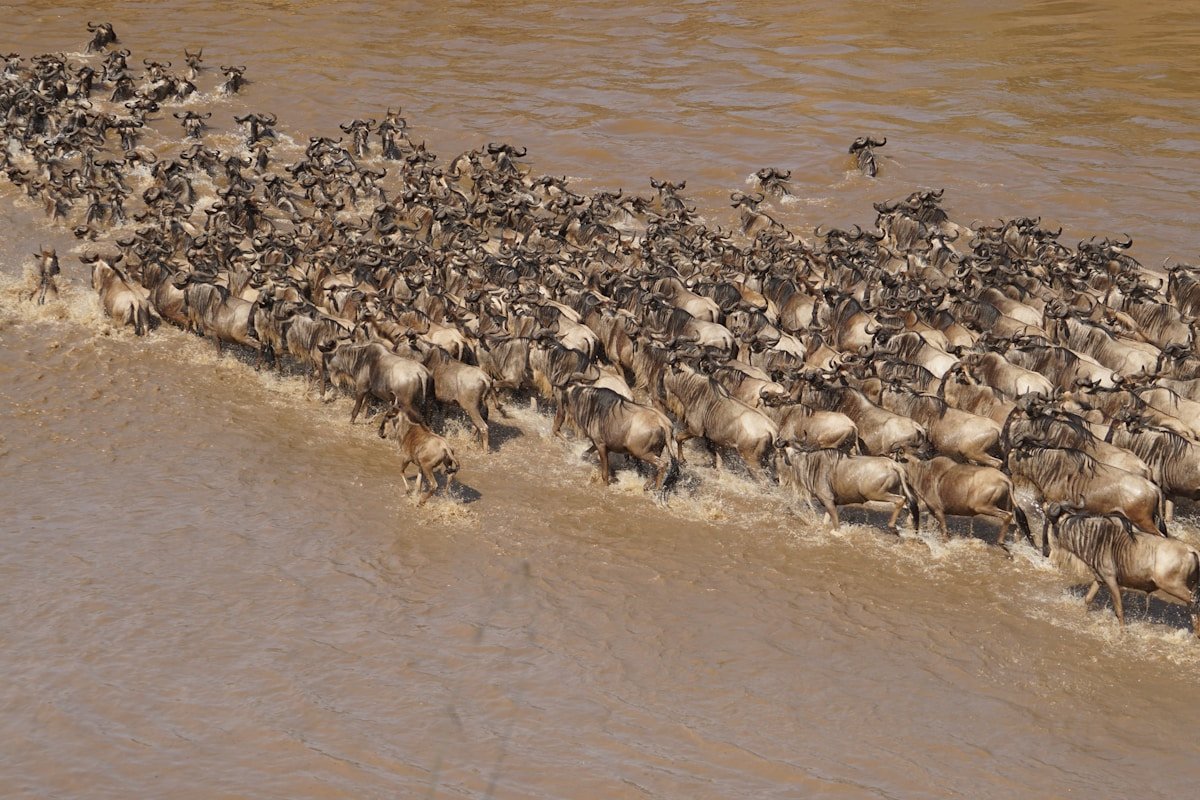
The Great Migration is the largest overland movement of mammals on earth - roughly 1.5 million wildebeest, 400,000 zebra and hundreds of thousands of gazelle follow the rains in a 1,000-kilometre loop between Tanzania’s Serengeti and Kenya’s Masai Mara. For most of the year the action happens entirely in Tanzania.
Knowing when to go and where to position yourself makes the difference between watching a distant herd graze and witnessing a 10,000-strong river crossing with crocodiles in the water.
The Annual Cycle
The migration is not a single event - it’s a continuous loop that changes character each month.
December–March: Calving season (Southern Serengeti) Around 500,000 wildebeest calves are born in roughly six weeks, peaking in February. The southern plains around Ndutu attract predators in numbers you rarely see elsewhere: cheetah, lion, leopard and hyena all converge on this buffet. Visibility across the short-grass plains is excellent.
April–May: Long rains - the herds move north The rains arrive and the column of animals begins pushing northwest toward the Western Corridor. This is the “shoulder season” - camp prices drop, crowds are thin, landscapes are intensely green. The crossing of the Grumeti River happens sporadically from May onward.
June–July: Western Corridor - Grumeti River crossings The herds reach the Grumeti River, where large resident crocodiles make for dramatic crossings. These are more predictable than the Mara crossings and far less visited. June is considered one of the best months for wildlife overall: the dry season begins, animals congregate near water, and bush has thinned out.
July–October: Northern Serengeti and Mara River crossings This is what most people come for. The herds mass in the Lamai and Kogatende areas of the Northern Serengeti from late July onward, crossing and re-crossing the Mara River. Crossings happen multiple times per day at peak, or only once in three days during quieter periods - they’re dictated by wildebeest mood as much as logistics. No guide can guarantee a crossing. What they can guarantee is positioning you at the right crossing points and waiting.
November: Return migration The short rains begin and the herds drift south again. The return crossing at the Mara River can be spectacular, and camps have far fewer guests than the July–October peak.
Key Crossing Zones
Mara River (Northern Serengeti): The famous crossings happen at several points along a 30-kilometre stretch of the Mara River inside the Serengeti (north of the border with Kenya). The main crossing points are at Crossing 1 (near Kogatende airstrip) and the Lamai area. Guides track herd movements via radio networks and position vehicles at likely crossing points.
Grumeti River (Western Corridor): Less-visited crossings with enormous crocodiles - some are more than five metres long. The Singita Grumeti concession controls much of the river access in this area, but public Serengeti vehicles can access certain sections.
Ndutu / Southern Plains: No dramatic river crossings, but the calving season concentrations and the predator action around February are among the most remarkable wildlife spectacles on the continent.
Getting Into Position: Camps and How to Choose
The migration covers a vast area - you need to stay in or very near the active zone. Flying between camps in small Cessnas is the most efficient approach. Driving from Arusha to the Northern Serengeti takes 8–10 hours each way.
Budget-conscious options (camping and budget lodges)
Search hotels in Arusha on Booking.com
Seronera Public Campsite - Located near the Seronera river junction in central Serengeti, this site has basic facilities (long-drop toilets, cold water). You bring your own tent and food. Camping fees from approximately USD 30 per person per night, plus park entry fees. Best for calving season and the general Seronera wildlife circuit rather than river crossings.
Kati Kati Tented Camp - A mid-range mobile camp that relocates seasonally to follow the migration. Rates from approximately USD 250–350 per person per night, full board.
Mid-range options (USD 350–700 per person per night)
Serengeti Sopa Lodge - A fixed lodge near Seronera with a swimming pool, en-suite tents and reasonable all-inclusive rates. Good for families. Rates from approximately USD 400 per person per night.
Mara Under Canvas - Part of &Beyond’s mobile camp portfolio, positioned near the Mara River in the peak July–October season. Moves with the migration. Rates from approximately USD 550 per person per night, all-inclusive.
Olakira Camp - Another mobile camp with a strong reputation for guide quality. Positioned near Ndutu in calving season, Northern Serengeti during crossings. Rates from approximately USD 600 per person per night.
Luxury options (USD 1,000+ per person per night)
Singita Mara River Tented Camp - Arguably the finest camp on the Mara River, with six tents on a private 350,000-acre concession. Rates from approximately USD 1,800 per person per night, fully inclusive. Game drives are limited to Singita vehicles only, so you share the crossing with far fewer vehicles than the public zones.
Four Seasons Safari Lodge Serengeti - A fixed luxury hotel near Seronera with a pool and spa. More resort-feel than bush camp, but the wildlife around Seronera is year-round excellent. Rates from approximately USD 900 per person per night.
andBeyond Klein’s Camp - On the northern boundary of the Serengeti, adjacent to the Lamai Wedge. Position is ideal for river crossing season. Rates from approximately USD 1,400 per person per night, fully inclusive.
Park Entry Fees (as of 2026)
The Serengeti’s entry fees are among the highest in Africa - and they are per day, not per visit.
- Non-resident adults: USD 82 per person per day
- Non-resident children (5–15): USD 41 per person per day
- Vehicle fee (non-resident registered): USD 40–200 depending on vehicle seats
These fees are paid through the Tanzania National Parks (TANAPA) TAZAMA digital card system. Most camps include them in their rates - confirm before booking.
How to Reach the Northern Serengeti
By air: Scheduled flights operate from Arusha to Kogatende (Northern Serengeti) and Lamai airstrips with Auric Air, Air Excel and Coastal Aviation. Flight time is approximately 2 hours. Flights connect to Nairobi, Dar es Salaam and Zanzibar via Arusha.
By road: 4WD from Arusha takes approximately 8–10 hours via Naabi Hill Gate, longer to the Kleins Gate northern entry. This is a genuine expedition and only sensible if you are combining with other Serengeti zones and have several days in transit.
Practical Tips
- Book vehicles and camps at least 6 months ahead for peak crossing season (July–October). Good mobile camps sell out 12 months in advance. You can also browse Great Migration safari tours from verified operators with recent traveller reviews.
- Not sure which month to go? Our month-by-month migration timing guide breaks down herd locations, crossing probability, camp prices, and booking lead times for every month of the year.
- Two nights minimum in any one migration zone - the crossing rhythm is unpredictable and you want multiple mornings at the river.
- Binoculars are essential - you often watch the herd build on the far bank for an hour or more before they move.
- The “Migration Season” dates advertised by camps are approximate - migration timing shifts by several weeks depending on rainfall. A wet June can delay the northern push significantly.
- Combined Serengeti + Masai Mara itineraries can legally cross the border with the right vehicle and border permissions. The crossing point at Isibania is used frequently. This gives you coverage of both sides of the river.
Frequently Asked Questions
Is there a single “best month” to see the Great Migration? July and August offer the highest probability of witnessing Mara River crossings in Tanzania. February is best for calving. June combines green landscapes with early crossings and lower prices.
Can you see the migration on a budget? Yes - budget camping inside the Serengeti is possible with your own 4WD and camping equipment, though you’ll need to plan game drives from public campsite locations. Combined with park entry fees, expect around USD 130–200 per person per day including camping, meals and fuel.
How long should you stay in the Northern Serengeti during crossing season? Three nights is a reasonable minimum. With only one night, you might see nothing. With three to five nights at a well-positioned camp near the Mara River, your chances of witnessing at least one substantial crossing are high.
What happens if you don’t see a crossing? The rest of the Northern Serengeti ecosystem still delivers: lion prides, elephant, giraffe and leopard are resident year-round. The landscape alone - rolling kopje plains and acacia woodland - is worth the journey.
To book a migration safari, browse Serengeti safari tours for operator comparisons across all budget tiers. Given that medical evacuation from the Serengeti can run USD 15,000+, travel insurance for Tanzania with emergency evacuation cover is non-negotiable.