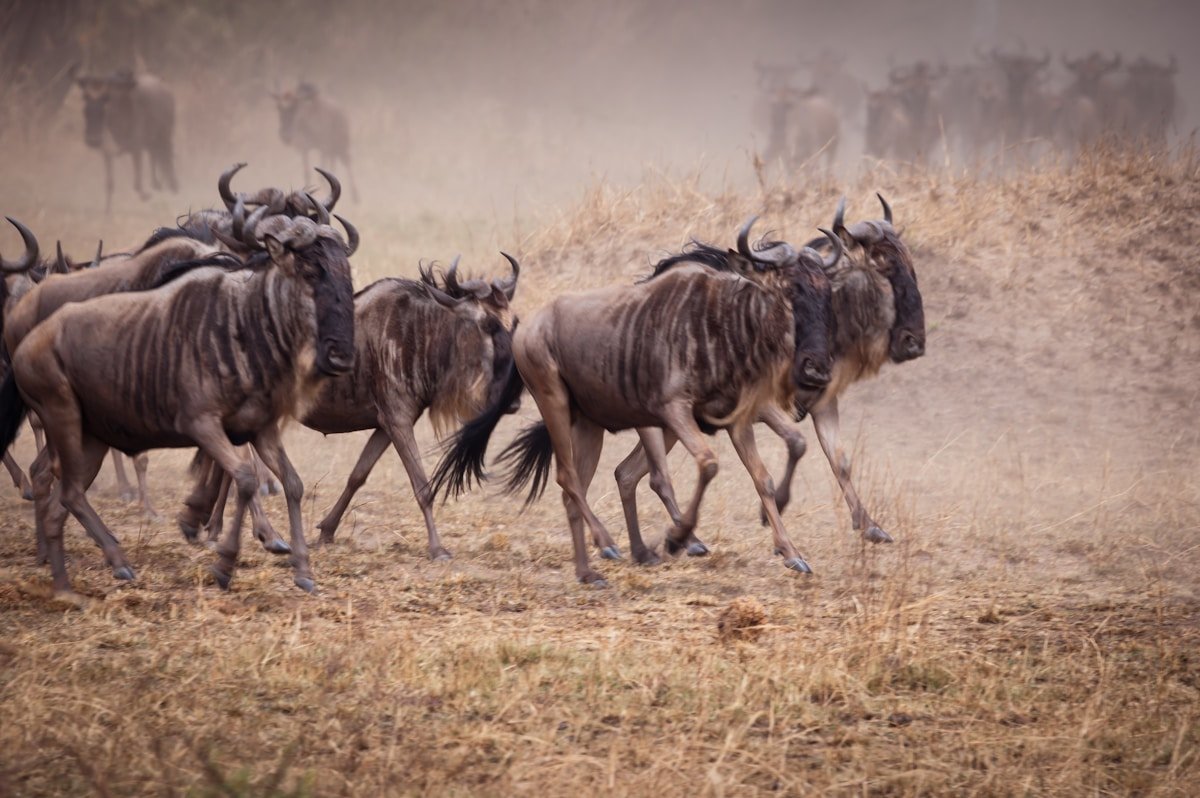
The Great Migration is a continuous loop - around 1.5 million wildebeest, 400,000 zebra, and several hundred thousand gazelle moving clockwise through the Serengeti and Kenya’s Masai Mara in response to rainfall and grass quality. There is no single best month. There is only the month that aligns with what you want to see.
For an overview of the migration as a wildlife spectacle - crossing zones, camp choices by budget, and how to reach the northern Serengeti - see our Great Migration destination guide.
This guide breaks down every month: where the herds are, what behaviour to expect, which camps give you the best access, and what you’ll pay.
How to Read Migration Timing
The timing shifts by 2–6 weeks in either direction depending on rainfall. A late wet season delays the northward push; an early dry season accelerates it. What follows are typical patterns - treat them as probabilities, not guarantees. Any reputable operator will adjust your camp positioning based on real-time herd data from their field guides.
Month-by-Month Migration Guide
| Month | Herd Location | Key Behaviour | Season |
|---|---|---|---|
| January | Southern Serengeti / Ndutu | Pre-calving congregation, short-grass grazing | Green season |
| February | Ndutu / Southern plains | Peak calving - 8,000 calves/day | Green season |
| March | Southern → Central Serengeti | Post-calving movement north begins | Late green season |
| April | Central / Western Corridor | Northward push, Grumeti River approaches | Long rains |
| May | Western Corridor | Grumeti River crossings begin | Long rains |
| June | Central → Northern Serengeti | Herds pushing north; early Mara attempts possible | Dry season starts |
| July | Northern Serengeti (Kogatende / Lamai) | Peak Mara River crossings | Peak dry season |
| August | Northern Serengeti | Crossings continue; peak crowd period | Peak dry season |
| September | Northern Serengeti → Kenya | Crossings winding down; herds may push into Masai Mara | Dry season |
| October | Central / Southern Serengeti | Return migration begins; herds dispersing south | Short rains |
| November | Central → Southern Serengeti | Return crossings; herds moving to southern plains | Short rains |
| December | Southern Serengeti / Ndutu approach | Herds arriving on southern plains; green grass flush | Green season |
January - Pre-Calving Build-Up
Where the herds are: Southern Serengeti and the Ndutu area (Ngorongoro Conservation Area boundary). The short-grass plains between Ndutu and Lake Masek fill up as the rains bring a carpet of new grass.
What to expect: Wildebeest are grazing steadily, building condition before the February calving explosion. Zebra are mixed in, and the flat open plains make for excellent predator viewing - cheetahs in particular are highly visible.
Best camps:
- Ndutu Safari Lodge - the original Ndutu-area camp, from approximately USD 550 per person per night full board (peak)
- Sanctuary Ndutu Serengeti Camp - tented camp right in the action, from approximately USD 700 per person per night
- Lemala Ndutu - well-positioned and often less crowded than rivals, from approximately USD 650 per person per night
January cost note: High season pricing is in effect due to calving. Budget at least USD 400–700 per person per night for a well-positioned camp.
February - Calving Season Peak
Where the herds are: The Ndutu area and southern Serengeti plains. This is the epicentre of one of Africa’s most extraordinary wildlife events.
What to expect: Around 8,000 wildebeest calves are born every day at peak calving, which falls between late January and mid-March with February as the apex. Within minutes of birth, calves are running with the herd - a necessary survival mechanism as cheetahs, lions, leopards, hyenas, and jackals all converge on the area. The predator density in February around Ndutu is unmatched anywhere in Africa.
This is genuinely one of the best months in Tanzania - visually dramatic, incredibly active, and still relatively few visitors compared to the July–August crossing crowds.
Best camps:
- Ndutu Safari Lodge - pioneer camp in the area, consistent lion and cheetah visibility, from USD 550/person/night
- &Beyond Ngorongoro Crater Lodge - luxury option with crater and Ndutu access, from USD 1,200/person/night
- Serengeti Under Canvas (Ndutu) - mobile camp, repositions as herds move, from USD 900/person/night
March - Post-Calving Movement Begins
Where the herds are: Gradually spreading north from the southern plains through Central Serengeti. The column begins forming as the long rains approach and green grass diminishes.
What to expect: Calving is finishing and the column starts its northward push. Predators remain active on the margins. This is a shoulder period - excellent wildlife viewing but the dramatic calving has peaked.
Best camps:
- Serengeti Serena Safari Lodge (central) - solid mid-range option, from approximately USD 400/person/night
- Four Seasons Safari Lodge Serengeti - large luxury property near Seronera, from approximately USD 800/person/night
March cost note: Early long-rains pricing begins in mid-March; prices drop 20–30% versus February.
April - Long Rains, Western Corridor
Where the herds are: Moving northwest through the Central Serengeti and into the Western Corridor (between Seronera and the Grumeti River).
What to expect: This is Tanzania’s green season, and the Serengeti is at its most photogenic - dramatic skies, lush vegetation, resident animals in good condition. The herds are on the move through the western corridor. Grumeti River crossings begin for some animals. Vehicles are scarce. This is legitimately excellent safari time for travellers who can handle occasional afternoon rain.
Best camps:
- Serengeti Bushtops (western corridor) - luxury tented camp in a private concession, from USD 750/person/night (green season rates apply)
- Grumeti Serengeti Tented Camp - classic camp near Grumeti River, from USD 500/person/night green season
April cost note: Long-rains rates are in effect: expect 30–50% reductions on many properties versus peak prices.
May - Grumeti River Crossings
Where the herds are: Western Corridor, focused on the Grumeti River.
What to expect: The Grumeti River crossings happen here. These crossings are less famous than the Mara River but arguably more dramatic in one way - the Grumeti’s resident Nile crocodiles are the largest in Africa (some exceed 5 metres). The vegetation is still thick from the rains, which challenges visibility but rewards patience. Far fewer vehicles than at July’s Mara crossings.
Best camps:
- Singita Grumeti - exceptional private reserve with near-exclusive access to the river, from USD 1,500/person/night. Worth the premium if Grumeti crossings are your target.
- Kirawira Serena Camp (western corridor) - period-tented camp overlooking the Grumeti, from approximately USD 450/person/night green season
June - Herds Push North, Dry Season Begins
Where the herds are: The column stretches from the Central Serengeti up through the Northern Serengeti toward Kogatende. Early Mara River crossing attempts may occur in the last two weeks of June.
What to expect: The dry season begins. Bush thins out. Animals concentrate near water. June is considered by many guides the best all-round month in Tanzania - the migration is building in the north, predator activity across the Serengeti is high, Kilimanjaro is in prime climbing condition, and camp rates are often still at mid-season levels before the July spike.
Best camps:
- Lemala Kuria Hills (northern Serengeti) - first-rate tented camp in the Lamai area, from USD 650/person/night
- Nomad Serengeti Safari Camp - mobile camp that tracks the herds, from USD 600/person/night
- Seronera areas remain excellent for resident predators even as the migration herds push north.
July - Peak Mara River Crossings
Where the herds are: Northern Serengeti, concentrated between the Kogatende section (around Mara River Crossing 1, near Kogatende airstrip) and the Lamai Triangle.
What to expect: This is what most people envision when they think of the Great Migration. The wildebeest column - stretching miles across the plains - reaches the Mara River and begins attempting crossings. On a good day, crossings happen two or three times. On a slow day, the herds mill at the bank for hours then turn back without crossing. No guide can guarantee a crossing - it happens on wildebeest time.
When a crossing does happen, it is extraordinary. Thousands of animals plunge into the river simultaneously, Nile crocodiles attack from the water, and a column of animals stretches up the far bank into Kenya. The noise, dust, and chaos are unlike anything else in wildlife.
July is peak season - expect maximum camp occupancy and prices.
Best camps for crossing access:
- Alex Walker’s Serian (Lamai) - intimate camp with excellent guide-to-guest ratio, from USD 950/person/night
- Lemala Kuria Hills - positioned in the Lamai Triangle, from USD 800/person/night
- Sanctuary Kichakani Serengeti Camp - good access to Kogatende crossings, from USD 850/person/night
- Lamai Serengeti (andBeyond) - premier luxury option, from USD 1,200/person/night
July cost note: This is the most expensive month. Budget USD 700–1,500 per person per night for a well-positioned camp. Book 6–12 months ahead.
August - Crossings Continue, Crowds Peak
Where the herds are: Northern Serengeti and starting to push into Kenya’s Masai Mara. Crossings at both the Tanzania and Kenya sides of the Mara River.
What to expect: Very similar to July. Crossings continue, predators follow the herds, and the Lamai and Kogatende areas are at maximum activity. The main differences versus July: a marginal decrease in crossing frequency as some herds move deeper into Kenya, and the peak of tourist numbers. Vehicles at crossing points can reach 20–30 at busy moments.
Best camps: Same as July. Camp operators at this time of year are optimising for crossing proximity above all else.
August cost note: August is as expensive as July. Prices identical to July peak.
September - Final Crossings, Return Migration Approaches
Where the herds are: Divided between the Northern Serengeti and Kenya’s Masai Mara. Some herds begin their return journey south in late September.
What to expect: Early September still delivers crossings, but frequency is declining. The return crossings - wildebeest heading back south across the Mara - can be spectacular, often less watched than the northward crossings. Camp prices begin to soften from mid-September onward.
Best camps: Northern Serengeti camps as in July–August, with the added option of Kenya-side Masai Mara camps if you want to follow the herds into Kenya. For Tanzania-based return migration crossings, Lamai Triangle remains the prime position.
September cost note: First two weeks similar to August; second half begins to drop 10–20% as peak season wanes.
October - Return Migration Through Central Serengeti
Where the herds are: Moving southward through the Central Serengeti and Seronera area. Short rains begin to arrive, signalling the southern plains.
What to expect: The short rains bring a flush of green grass, and the herds respond. Predator activity in the Seronera area is high as the migration column passes through. This is a value month - excellent wildlife, moderate crowds, prices well below peak.
Best camps:
- Serengeti Under Canvas (mobile - moves to follow herds) - from USD 500/person/night
- Seronera-area camps - all benefit from the migration column passing through. Serengeti Serena from USD 350/person/night.
November - Short Rains, Herds Heading South
Where the herds are: Southern Serengeti and approaching the Ndutu area for the pre-calving assembly.
What to expect: The short rains soften the landscape and the herds are moving toward the southern plains. Visitor numbers drop significantly - one of the lower occupancy months of the year. Some camps close or reduce staff in November.
Best camps:
- Most Central and Northern Serengeti camps remain open. Four Seasons Safari Lodge and Serengeti Serena are year-round options.
- Some Ndutu-area camps begin setting up for the calving season.
November cost note: Green season rates apply. Camp prices at their lowest. Excellent value month.
December - Southern Arrival, Pre-Calving Build-Up
Where the herds are: Southern Serengeti plains and the Ndutu area, gathering on the short-grass plains ahead of January–February calving.
What to expect: A mirror of January. The grass is green, animals are arriving, and the short-grass plains between Lake Ndutu and Seronera are filling up. Christmas–New Year week is an exception - prices spike and occupancy jumps across the whole Serengeti as families take the holiday period.
Best camps:
- Ndutu Safari Lodge - from USD 450/person/night (pre-Christmas), up to USD 700/person/night over the holiday week
- Lemala Ndutu - from USD 600/person/night peak
Planning Your Migration Safari
Search hotels in Arusha on Booking.com
Booking Lead Times
- July–August crossings: Book 9–12 months in advance. Camp availability disappears fast.
- February calving: Book 6–9 months in advance.
- April–June and October–November: You can often book 1–3 months out and find good availability.
Getting There
The most efficient approach is to fly into Kilimanjaro International Airport (JRO) and connect via scheduled light aircraft to the relevant Serengeti airstrip:
- Ndutu / Southern Serengeti: Ndutu airstrip (approx 20-minute flight from Seronera)
- Kogatende / Northern Serengeti: Kogatende airstrip or Lamai airstrip (50-minute flight from Seronera or direct from Kilimanjaro on some operators)
- Seronera (Central): Seronera airstrip
Most camps quote prices inclusive of all game drives and meals. Park fees (approximately USD 82 per adult per day in peak zones) are usually charged separately.
Browse Serengeti migration safari packages - most operators offer 4–7 night packages positioned by the current herd location. Get travel insurance before departure - medical evacuation from the northern Serengeti can cost USD 5,000–10,000 without it.