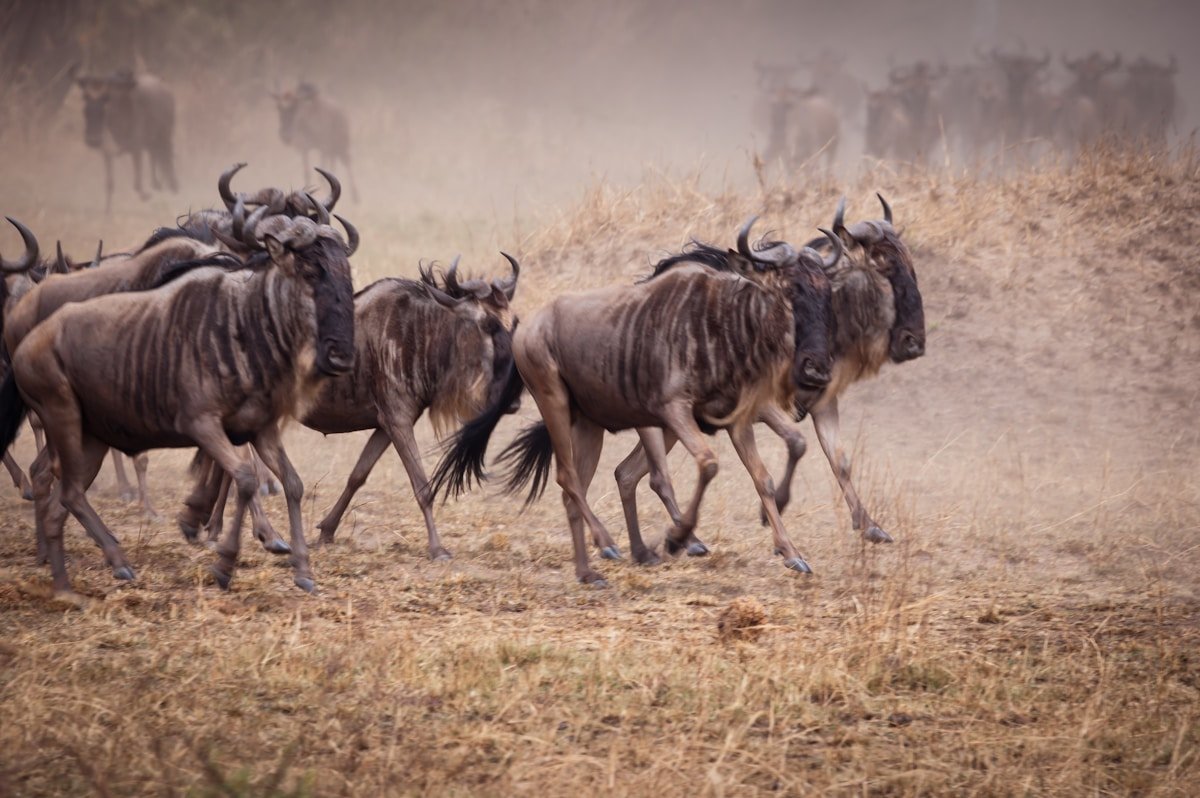
The Serengeti National Park is Tanzania’s most celebrated wildlife destination and one of the oldest ecosystems on earth. Covering 14,763 sq km of open savannah, acacia woodland, kopje granite outcrops, and riverine forest, it protects a resident wildlife population that includes all five of the Big Five alongside cheetah, wild dog, hundreds of bird species, and the largest land migration of any animal on earth.
Entry fees are USD 82 per person per day (as of 2026) for non-resident adults, paid through the Tanzania National Parks authority. The park has no formal opening hours — camps and lodges operate around the clock, and night game drives are permitted within certain concession areas, though standard day visitors must depart by 6pm.
The Great Migration
The defining event at the Serengeti is the Great Migration: approximately 1.5 million wildebeest, 250,000 zebra, and 500,000 Thomson’s gazelle circling continuously between Tanzania and Kenya’s Masai Mara. The animals follow rainfall and fresh grazing, making their movement broadly predictable by season.
From January to March, the enormous calving concentrations gather in the short-grass plains of the south near Ndutu. Roughly 500,000 wildebeest calves are born in a concentrated six-week window — predator activity during this period is exceptional. April and May bring the long rains; herds begin moving north through the central Seronera corridor. June to July sees the migration reach the Western Corridor and the Grumeti River, where crocodiles ambush crossing animals. August to October is the peak of the Mara River crossings in the far north near Kogatende and Lamai — the most dramatic spectacle of the circuit. November to December, herds turn south again toward Ndutu.
Wildlife Beyond the Migration
The central Seronera valley holds resident lion prides, leopard that hunt from the dense riverine forest, and cheetah on the open plains year-round. Elephant herds move through the western woodlands. The kopjes — granite outcrops scattered across the plains — shelter klipspringer, hyrax, and are favoured resting spots for lion and leopard. The Serengeti also supports one of Africa’s healthiest spotted hyena populations.
Birding is outstanding. The park holds over 500 bird species including kori bustard, secretary bird, martial eagle, and enormous concentrations of vultures that follow the migration.
Where to Stay
Luxury
Four Seasons Safari Lodge Serengeti sits on a kopje above a waterhole in the central Serengeti and is the only hotel in the world with a natural waterhole visible from the property. Rooms start at approximately USD 1,200 per person per night (full-board, as of 2026) and include game drives. Rated 9.6 on Booking.com.
Serengeti Serena Safari Lodge is set on a tree-clad ridge with a vanishing-horizon pool overlooking the plains. Built in the Maasai architectural style, it offers 66 en-suite rooms from approximately USD 650 per person per night (full-board, as of 2026). Rated 9.3 on Booking.com.
Mid-Range
Serengeti Wildebeest Camp sits within a private concession area in the Western Serengeti and offers tented accommodation at around USD 300 to 450 per person per night (full-board, as of 2026). The smaller camp size means fewer vehicles at wildlife sightings.
Budget
The TANAPA public campsite at Seronera offers basic facilities at USD 35 per person per night (as of 2026), excluding park entry fees. You must be fully self-sufficient and bring all food, water, and equipment. Self-drive safaris are permitted in private vehicles.
Getting There
From Arusha by air: Chartered flights from Arusha’s Kilimanjaro International Airport connect to multiple Serengeti airstrips including Seronera, Grumeti, and Kogatende. Flight time is approximately 45 minutes to Seronera; cost ranges from USD 250 to 500 per person one-way (as of 2026) depending on operator and route.
From Arusha by road: The drive from Arusha to the Naabi Hill gate takes approximately 7 to 8 hours on tarmac and graded dirt roads. The route passes through the Ngorongoro Conservation Area (additional fees apply). Most visitors combine this drive with a stop at Ngorongoro Crater.
From Dar es Salaam: Fly to Kilimanjaro International Airport (1 hour 40 minutes, approximately USD 200 one-way, as of 2026) then connect to Serengeti as above.
Where to Eat
Food at lodges and tented camps is included in the full-board rate and is generally excellent — three-course dinners with African-inspired menus, bush breakfasts at sunrise, and picnic lunches in the field are standard at mid-range and luxury camps.
Speke’s Restaurant at Four Seasons serves international dishes alongside Tanzanian specialities in a setting with waterhole views. The dinner buffet runs approximately USD 65 to 80 per person (as of 2026) for non-resident day visitors.
At Seronera, the TANAPA visitor centre has a small café offering basic snacks and drinks. Options are limited — bring your own packed lunch if you are on a day visit without a lodge booking.
When to Go
The northern Mara River crossing season (July to October) is the most-requested window and commands peak pricing across all lodges. The calving season at Ndutu (January to March) offers exceptional predator sightings at lower rates than peak. The green season (April to June) brings the lowest rates, lush landscapes, and few other visitors — wildlife is excellent even without migration concentrations.
Practical Notes
- Park entry fees are charged per calendar day, not per 24 hours. Arriving late and leaving early still counts as two days.
- Book lodges at least 6 months in advance for July to October visits. Popular properties sell out a year or more ahead.
- The Serengeti has no ATMs. All payments must be settled by card or cash in advance through your camp or operator.
- Mobile signal is unreliable throughout the park. Download offline maps before arrival.
- Yellow fever vaccination is required for entry to Tanzania if arriving from certain countries. Check current requirements with your embassy before travel.