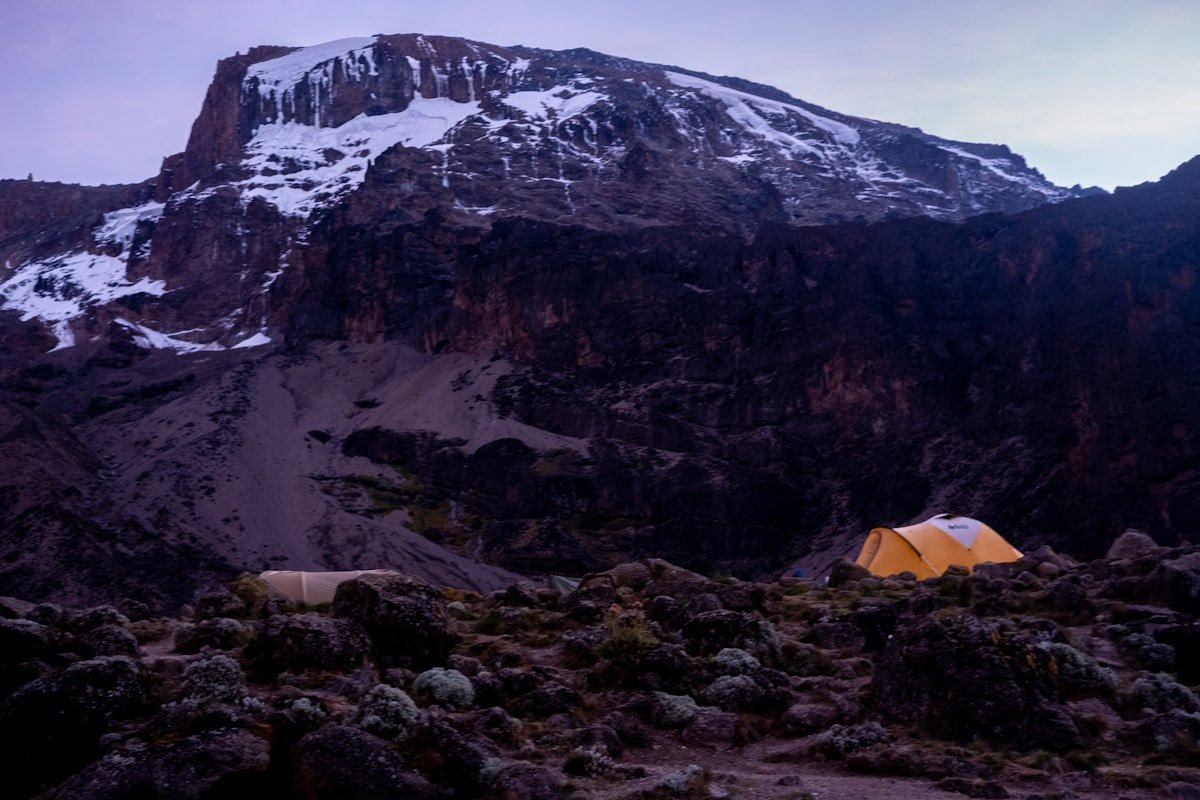
The Northern Circuit is the newest official route on Kilimanjaro and the one that takes the longest. Nine days. It begins like the Lemosho Route via the western Londorossi Gate, crosses the Shira Plateau, then - instead of dropping to Barranco - traverses the remote northern face for two additional days before swinging south to join the standard Barafu summit approach. The result is a near-complete circumnavigation of Kibo, with the highest acclimatisation profile and the highest summit success rate of any route on the mountain.
This is not the route for tight schedules or tight budgets. But if you can commit to nine days on the mountain, the Northern Circuit gives you the best odds of reaching Uhuru Peak.
Difficulty: Moderate (terrain), easier (acclimatisation due to long duration) Duration: 9 days Success rate: approximately 90–95% Approach: Western flank via Londorossi Gate (2,100m) Summit: Uhuru Peak (5,895m) via Barafu and Stella Point Descent: Mweka Route
Why the Northern Circuit Has the Highest Success Rate
Every extra day on the mountain is another day your body produces more red blood cells, adapts to lower oxygen saturation, and burns through AMS risk. The Northern Circuit adds two to three days compared to Machame - specifically in the 4,000–5,000m altitude range where acclimatisation matters most. By the time trekkers reach Barafu Base Camp on Day 7 or 8, most have already spent multiple nights above 4,000m and the summit push feels genuinely different from a 6-day Machame attempt.
The other factor is solitude. The northern face is the quietest section of Kilimanjaro; few groups reach Moir Hut or the buffalo-free slopes above 4,200m on the north. Your guide team has time to monitor your health carefully without the pressure of busy camps and fixed schedules.
Altitude Profile
| Camp | Altitude | Night |
|---|---|---|
| Londorossi Gate | 2,100m | Arrival |
| Forest Camp | 2,750m | Night 1 |
| Shira 1 Camp | 3,500m | Night 2 |
| Shira 2 Camp | 3,840m | Night 3 |
| Moir Hut | 4,200m | Night 4 |
| Buffalo Camp | 3,960m (sleep low) | Night 5 |
| Third Cave / Pofu Camp | 3,950m | Night 6 |
| School Hut / Outward Bound | 4,200m | Night 7 |
| Barafu Camp | 4,673m | Night 8 |
| Uhuru Peak | 5,895m | Summit night |
| Mweka Camp | 3,100m | Night 9 |
| Mweka Gate | 1,650m | Final day |
Note: Camp names and exact altitudes vary slightly between operators. Some use Kosovo Camp (4,800m) as an optional camp before Barafu.
Day-by-Day Itinerary
Day 1: Londorossi Gate (2,100m) → Forest Camp (2,750m)
Distance: 5km | Time: 3–4 hours | Gain: +650m
Drive from Moshi to Londorossi (approximately 90 minutes). Same forest approach as Lemosho - gentle first afternoon through montane rainforest. Camp near the upper forest line.
Day 2: Forest Camp (2,750m) → Shira 1 Camp (3,500m)
Distance: 8km | Time: 5–7 hours | Gain: +750m
Exit the forest and cross onto the Shira Plateau. The landscape opens dramatically. First views of Kibo summit cone from the plateau’s western edge.
Day 3: Shira 1 Camp (3,500m) → Shira 2 Camp (3,840m)
Distance: 7km | Time: 4–5 hours | Gain: +340m
Cross the plateau. Optional Shira Cathedral excursion (3,962m) for acclimatisation - most operators include this. Excellent views of Kibo and Mawenzi. Temperature at Shira 2 at night drops to near-freezing even in dry season.
Day 4: Shira 2 Camp (3,840m) → Moir Hut (4,200m)
Distance: 8km | Time: 5–6 hours | Gain: +360m
Here the Northern Circuit diverges from Lemosho. Instead of heading southeast toward Lava Tower, you turn north and climb to Moir Hut - a remote camp on the mountain’s northern flank with almost no other trekkers. Views of Mawenzi’s dramatic rocky towers to the east. The sense of remoteness is striking after the relative bustle of Shira.
An optional excursion to Lent Hills (4,450m) from Moir Hut provides further acclimatisation and outstanding panoramic views.
Day 5: Moir Hut (4,200m) → Buffalo Camp (3,960m)
Distance: 9km | Time: 5–6 hours | Net change: −240m
A day that intentionally loses altitude - “climb high, sleep low” on a macro scale. You traverse the northern face at altitude (4,200–4,400m) before descending to Buffalo Camp (3,960m) for the night. The northern slopes here are genuinely remote. This day is physically moderate but psychologically significant: your body processes the altitude work while sleeping at a slightly lower level.
Day 6: Buffalo Camp (3,960m) → Pofu Camp or Third Cave (3,950m)
Distance: 9km | Time: 5–6 hours | Net change: ~0m
Continue traversing the northern face, crossing through sparse moorland and volcanic rock. Mawenzi remains prominently to the east. You are now roughly at the same altitude as Horombo Hut on the Marangu Route but have been on the mountain for six nights - your acclimatisation far exceeds anything possible on a 5- or 6-day route.
Day 7: Pofu Camp (3,950m) → School Hut or Outward Bound Camp (4,200m)
Distance: 7km | Time: 4–5 hours | Gain: +250m
Begin moving south, meeting the northern end of the Rongai Route trail. The landscape transitions from the wild northern slopes toward the more travelled eastern approach. School Hut is a quieter alternative to Kibo Hut for groups with space.
Day 8: School Hut (4,200m) → Barafu Camp (4,673m)
Distance: 7km | Time: 4–5 hours | Gain: +473m
The final day before the summit push. Barafu Camp sits on a rocky ridge above the Southern Cirque. By Day 8, most Northern Circuit trekkers feel remarkably well - the extended acclimatisation profile means altitude headaches that troubled them at Shira 2 have largely resolved. Rest all afternoon. Summit briefing. Early night.
Summit Night: Barafu Camp (4,673m) → Uhuru Peak (5,895m)
Distance: 5km | Time: 5–8 hours ascent, 3–4 hours descent to Barafu
Wake at 11pm–midnight. Same summit trail as Machame - steep volcanic scree in darkness, followed by the crater rim traverse to Uhuru Peak. By this point in the itinerary, most Northern Circuit trekkers feel physically capable of the summit. The psychological difference from a 6-day attempt is significant: you are not struggling against altitude fatigue in the same way.
Stella Point (5,756m) on the crater rim. Uhuru Peak (5,895m) - the summit. The glaciers visible at close range at this altitude are a reminder that the mountain’s permanent ice, present for 10,000 years, is retreating measurably each decade.
Descend to Barafu, then continue to Mweka Camp (3,100m).
Day 9: Mweka Camp (3,100m) → Mweka Gate (1,650m)
Distance: 9km | Time: 3–4 hours
Final descent through rainforest. Summit certificate at the gate. Tip ceremony.
Who the Northern Circuit Is For
The Northern Circuit suits:
- Trekkers willing to invest nine days for the best possible summit odds
- Anyone who has failed Kilimanjaro before on a shorter route and wants the clearest path to success
- Groups who value solitude above all else
- Anyone with a specific interest in seeing the full range of Kilimanjaro’s landscapes and ecological zones
- Repeat visitors who’ve done Machame and want to see the northern face
This route is not ideal for:
- Trekkers with fewer than 9 days available in Tanzania
- Budget-focused travellers - the additional days add approximately $400–$700 per person over Lemosho
Named Operators and Prices (as of 2026)
| Operator | 9-Day Price (approx.) | Notes |
|---|---|---|
| Zara Tours | $2,200–$2,700 | Budget; available but less commonly offered |
| Roy Safaris | $3,100–$3,700 | Reliably offered; good logistics |
| Altezza Travel | $3,200–$3,900 | GPS tracking; strong emergency protocols |
| Kilimanjaro Experts | $3,000–$3,600 | Small groups preferred |
| Thomson Safaris | $5,500–$7,000 | Premium; private camps; recommended |
Not all operators run the Northern Circuit regularly - confirm availability and confirm the itinerary includes the full northern traverse (Moir Hut, Buffalo Camp) rather than a shortened version. Browse 9-day Northern Circuit packages from certified operators. Ensure your travel insurance covers trekking to 5,895m.
Acclimatisation Tips
The Northern Circuit’s length is its primary acclimatisation advantage - the route is specifically designed to let your body adapt gradually. Additional tips:
- Drink 3–4 litres of water daily throughout; the long duration means hydration discipline matters even on easier days
- Use the optional excursion from Moir Hut (Lent Hills) - it pays dividends at Barafu
- Diamox remains useful even on this longer route - discuss with your doctor
- Don’t underestimate Day 8 fatigue: nine days of high-altitude trekking accumulates genuine physical tiredness. Pace Day 8 as carefully as Day 1.
Packing List
As per the Machame Route guide. The extra days on the northern face require attention to:
- Sleeping bag: minimum −15°C rating - the northern camps at 4,200m are exposed
- Extra socks and base layers: nine days is long enough that you’ll want two complete sets
- Trekking poles: essential for balance on long traverses across volcanic scree
- Sun protection: the northern face has long exposed sections; use SPF 50+ daily