Tanzania is the most expensive safari destination in East Africa by any honest accounting, and understanding exactly what you’re paying for - and where the costs concentrate - makes the difference between a trip that fits your budget and one that doesn’t.
What drives the cost of a Tanzania safari?
Three cost categories dominate any Tanzania safari budget: park fees, accommodation, and transport.
Park fees are non-negotiable. Tanzania’s most visited parks charge among the highest non-resident entry fees on the continent, and multi-day itineraries in parks like the Serengeti accumulate fees quickly. A three-night/four-day itinerary covering the Serengeti alone costs approximately $320 USD per person in park fees before you’ve paid for a single meal.
Accommodation ranges from basic public campsites at around $35–50 USD per person per night to exclusive private conservancy lodges that routinely charge $800–2,000 USD per person per night. Most travellers land somewhere in the middle.
Transport - whether a shared group vehicle or a private 4×4 with guide - is a fixed cost that becomes more manageable the more passengers share it. Travellers combining a safari with independent road travel can also arrange car hire in Tanzania from Arusha, though virtually all safari circuits require a 4×4 with adequate clearance.
Budget tier: approximately $150–250 per person per day
Budget safaris mean group camping safaris departing from Arusha. You share a vehicle with up to seven other travellers, sleep in dome tents pitched at public campsites, and eat simple but filling communal meals prepared by a camp cook.
A typical three-day Serengeti and Ngorongoro safari costs approximately $850–1,100 USD per person in a group of four to six, inclusive of all park fees, camping fees, meals, and shared vehicle. That works out to roughly $280–370 USD per person per day - meaning budget safaris in Tanzania are closer to $250 than $150 once park fees are factored in.
What you trade: early morning departures in overcrowded public campsites, shared game drive vehicles with strangers, no private guiding, and public restroom facilities. Browse available group departures at Serengeti Safari Tours.
Mid-range tier: approximately $350–600 per person per day
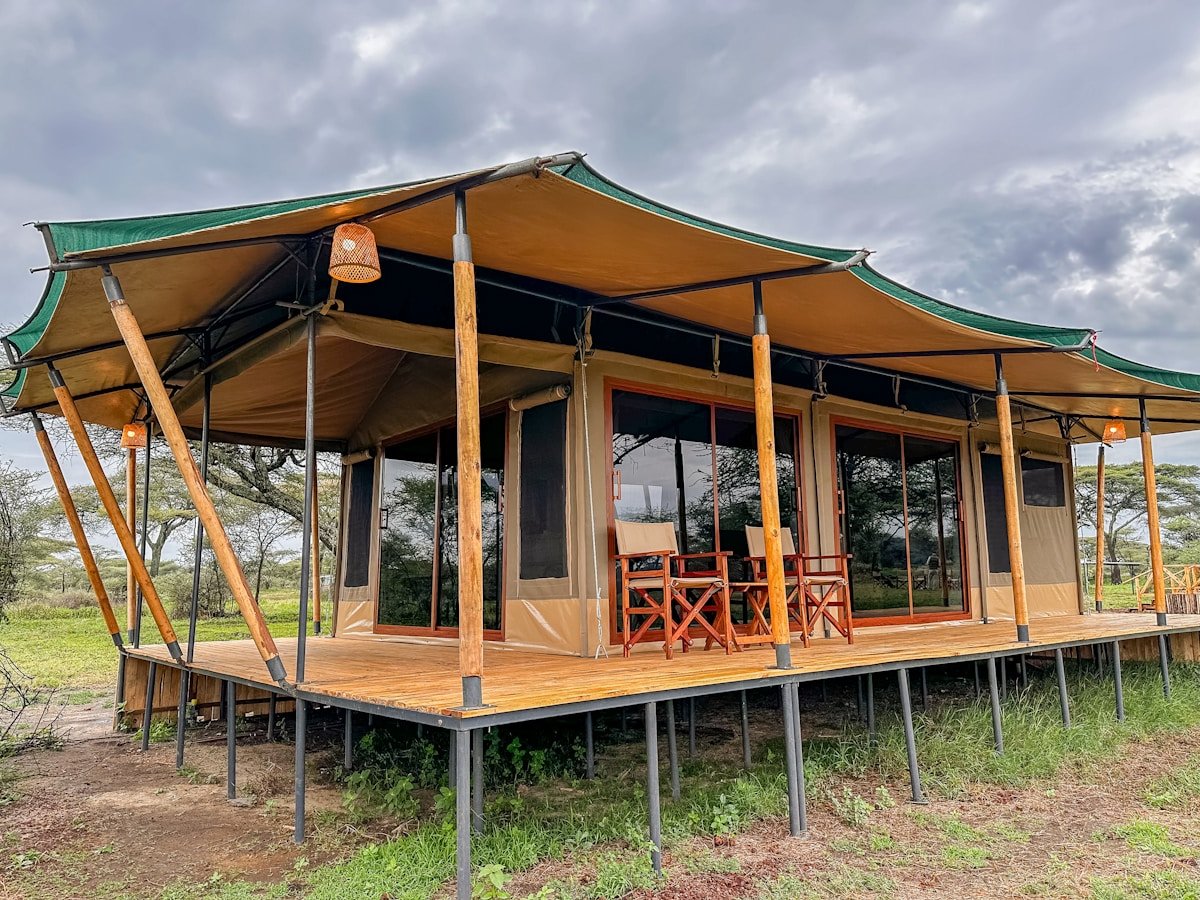
Mid-range means tented camps and small lodges inside or on the boundary of the major parks. Properties like Serengeti Tortilis Camp, Ngorongoro Farmhouse, or Tarangire Oliver’s Camp fall into this range, typically priced at $300–600 USD per person per night on an all-inclusive basis in 2026.
At this level you get a private en-suite tent or room, twice-daily game drives with a dedicated guide and vehicle, all meals, and substantially fewer fellow guests. Private vehicle hire adds $200–350 USD per day on top of accommodation, though many lodge-based itineraries include shared daily game drives within the price.
A six-day itinerary combining Tarangire, the Serengeti, and Ngorongoro at mid-range - three nights each split between two properties - typically totals $3,500–5,500 USD per person in 2026, excluding international flights. For a shorter option, a 4-day Serengeti and Ngorongoro safari is widely available from Arusha at the mid-range level.
Luxury tier: approximately $800–2,000+ per person per night
Tanzania’s luxury market is internationally competitive. Private conservancy camps such as andBeyond Serengeti Under Canvas, Singita Grumeti, or Nomad Tanzania’s Lamai Serengeti price at $800–2,000 USD per person per night fully all-inclusive, including private game drives, a dedicated guide, bush meals, and, in some cases, walking safaris and sundowner experiences.
At the very top - camps like Singita Faru Faru or Sanctuary Kusini - all-inclusive rates exceed $2,000 USD per person per night in peak season (July–October, 2026).
Fly-in itineraries using light aircraft between parks add approximately $400–800 USD per person per leg but save significant overland driving time.
Park fees breakdown (2026)
| Park | Fee per person per day (non-resident) |
|---|---|
| Serengeti National Park | $80 USD (high season) |
| Ngorongoro Crater | $100 USD per descent |
| Tarangire National Park | ~$53 USD |
| Lake Manyara National Park | ~$45 USD |
| Ruaha National Park | ~$50 USD |
| Nyerere (Selous) National Park | ~$50 USD |
Fees are paid in USD cash or by card through your operator. Ngorongoro Crater access requires a separate vehicle entry fee of approximately $200–300 USD for a half-day descent.
Domestic flights: what to budget
Light aircraft flights between the parks are a significant add-on for itineraries covering the northern and southern circuits. Common routes and approximate 2026 prices:
- Arusha (ARK/JRO) to Serengeti (various airstrips): $250–400 USD per person one-way
- Serengeti to Ngorongoro: $150–250 USD per person one-way
- Arusha to Ruaha or Nyerere: $400–600 USD per person one-way
Coastal Aviation, Auric Air, and Grumeti Air operate the main inter-park routes. Booking through your safari operator is standard; prices fluctuate with demand.
Seasonal price variation
Peak (July–October): Highest prices across all tiers. The Great Migration crossing season drives premium demand in the Serengeti.
Shoulder (November, January–February, June): Strong conditions with 10–25% savings versus peak. January–February is calving season in the southern Serengeti.
Low (April–May): The long rains bring discounts of 20–40% at properties that stay open, but green-season conditions mean some tracks are impassable and certain camps close entirely.
Tipping expectations
Tipping is expected and significant for safari guides and camp staff. The broadly accepted 2026 benchmark:
- Safari guide: $20–30 USD per day from the group (split if sharing)
- Camp/lodge staff: $10–15 USD per person per day left in a communal tips box
- Cook (camping safari): $5–10 USD per person for the trip
- Trackers and specialist guides: $10–15 USD per day from the group
Budget approximately $50–80 USD per person for a five-day trip in tips - more on luxury itineraries where service levels are higher.
What’s typically excluded
Even on “all-inclusive” packages, watch for these exclusions:
- International flights to Kilimanjaro (JRO) or Dar es Salaam (DAR)
- Tanzanian visa ($50 USD for most nationalities, applied online)
- Travel insurance (essential - medical evacuation from remote parks is expensive)
- Laundry beyond a basic wash-and-fold allowance
- Premium spirits and imported wine
- Optional activities: balloon safaris ($600–700 USD per person), cultural village visits, walking safaris
A hot-air balloon safari over the Serengeti costs approximately $650 USD per person and is not included in any standard package.
Is a Tanzania safari worth the cost?
Tanzania charges more than Kenya, Botswana (roughly comparable), and significantly more than Zimbabwe or Zambia. The premium reflects genuine quality: serious biodiversity, rigorous park management, and a relatively uncrowded landscape outside of the peak northern circuit. For first-time visitors to East Africa combining Serengeti with Zanzibar, the cost is harder to justify below the mid-range tier - at budget level, the park fees alone represent most of the value.
Plan Your Trip
✈️ Book your flights to Tanzania 🛡️ Get travel insurance 📱 Stay connected with an eSIM 🚗 Rent a car