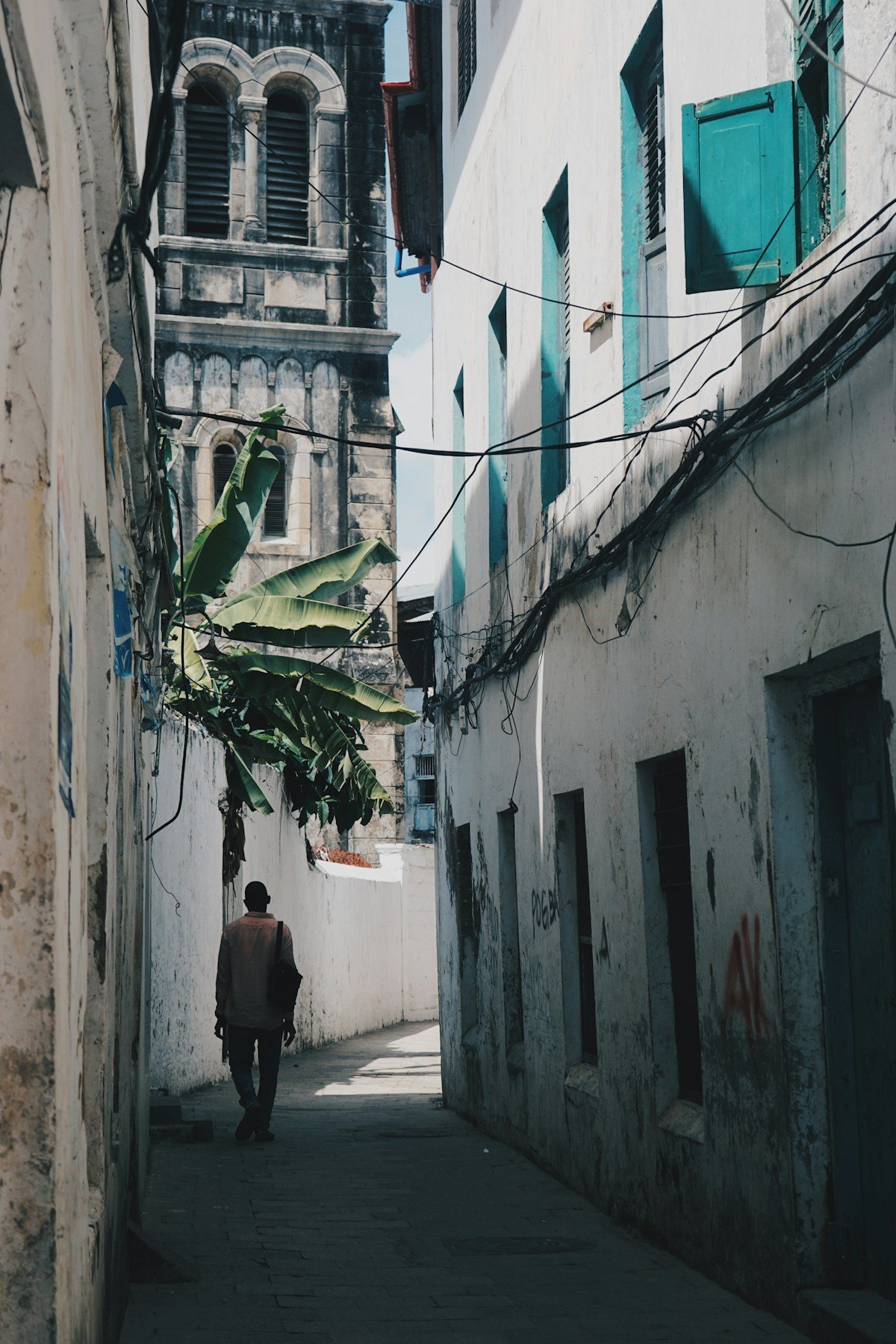
Stone Town is the old settlement on Zanzibar’s western shore - a compact grid of narrow lanes, whitewashed coral-stone buildings, and mosques that has barely expanded its footprint since the 19th century. It has been a continuous city since at least the 15th century, was the base of the Omani Sultanate from the 1820s, and at its peak was one of the most important trading ports in the Indian Ocean, handling slaves, ivory, cloves, and spices across routes to Arabia, India, and beyond. UNESCO designated it a World Heritage Site in 2000.
Today around 20,000 people live and work in the medina. It is not a museum - the alleys carry motorbikes and school children as well as tourists, and the smell of frying mishkaki mixes with brine from the harbour. That ongoing life is what makes it worth visiting.
Orientation
Stone Town divides loosely into three zones. The waterfront (Forodhani Gardens, the House of Wonders, the Old Fort) is where most visitors begin. The central medina, a tangle of lanes between Creek Road and the waterfront, contains most of the architecture, the Darajani Market, and the majority of the guesthouses and restaurants. The northern quarter around Ng’ambo is more residential.
Search hotels in Zanzibar on Booking.com
You can walk from one end of the historic district to the other in 15 minutes, but navigating the lanes is genuinely disorienting. A free map is available at the tourist office on Kenyatta Road; Google Maps works but does not have all the alleys mapped accurately.
Key Sights
Old Fort (Ngome Kongwe): Built by the Omanis between 1698 and 1701 on the site of a Portuguese church. The large open courtyard hosts a crafts market and occasional outdoor cinema. Entry is free. Open daily approximately 8am–6pm.
House of Wonders (Beit el-Ajaib): The largest building in Stone Town, built as a ceremonial palace in 1883 - the first building in Zanzibar with electricity and an elevator. It was damaged in 2020 when part of the facade collapsed. Check current access status before visiting; restoration has been ongoing.
Palace Museum (Beit el-Sahel): The former palace of the Zanzibar Sultanate, now a museum with personal effects of the last sultans, furniture, weapons, and photographs. Entry approximately USD 3. Open Saturday–Thursday approximately 9am–6pm, Friday 9am–12pm and 3pm–6pm.
Livingstone House: On Baghani Street, this is where David Livingstone made his final preparations before setting out for the interior in 1866. The exterior is easily visible; the interior is sometimes accessible via guided tour.
Christ Church Cathedral: Built on the site of the main slave market, consecrated in 1873 - the same year the slave trade was officially abolished in Zanzibar under pressure from the British Consul. The cathedral’s altar is said to sit where the whipping post stood. The slave chambers in the courtyard are a sobering exhibit. Entry approximately USD 3. Open Monday–Saturday approximately 9am–5pm.
Darajani Market: On Creek Road, at the eastern edge of the medina. Open every morning (busiest 7am–noon). Fresh fish, meat, spices, and produce. The covered fish market behind the main stalls shows the catch from the overnight dhow fleet.
Prison Island (Changuu Island): A 25-minute boat ride from Stone Town. The island has giant Aldabra tortoises (imported from Seychelles in the 1900s) and an old prison building that was never used as such. Boat return and island entry costs approximately USD 25–35 per person. Trips depart throughout the day from the Stone Town waterfront.
Guided Walks
A guided walk is by far the most efficient way to understand Stone Town. Guides point out the carved door archives, explain the history of specific buildings, and know the lanes well enough to show you courtyards and rooftops not obvious from the street.
Eco and Culture Tours (near the Old Fort, +255 777 422 006): Stone Town walking tours for approximately USD 15 per person, 2 hours. Well-regarded and locally owned.
Zan Tours: Larger operator that runs combination tours (Stone Town + Prison Island, or Stone Town + spice farm). Stone Town morning tour approximately USD 25–30 per person including transport.
Independent exploration is also rewarding - allow yourself to get lost. The main streets eventually lead back to the waterfront.
Eating in Stone Town
Forodhani Night Market: Opens at sunset on the waterfront. Vendors cook to order: grilled lobster (approximately USD 12–18 depending on size), zanzibar pizza (filled flatbread, approximately USD 2–4), sugarcane juice, urojo soup (around USD 1.50). Arrive before 8pm for the freshest selection.
Lukmaan Restaurant (New Mkunazini Road): Open from late afternoon, this is the most reliable local kitchen for biryani, rice and stew, and mishkaki skewers. Full meal under USD 5. No menu - just point at the pots.
Emerson Spice Teahouse (rooftop): The rooftop of Emerson Spice boutique hotel hosts a Swahili tasting menu at 7:30pm most evenings (booking required, approximately USD 40 per person). Overlooks the rooftops of the medina. One of the most atmospheric dining experiences on the island.
Mercury’s Restaurant (waterfront): Named after Freddie Mercury, who was born in Stone Town in 1946. Reliable fish dishes, pizza, and Tusker lager at mid-range prices (USD 10–20 per main). Good views of the harbour.
When to Visit
Stone Town is navigable year-round. The main rains (April–May) do not fundamentally change the experience inside the medina - the architecture is the draw, not the beach. If combining Stone Town with beaches, plan for the dry season (June–October) or January–February.
The Zanzibar International Film Festival (ZIFF), held annually in July, fills the Old Fort courtyard and various venues in Stone Town with screenings, music, and food. Book accommodation well ahead if your visit coincides.
Getting There
Stone Town is served by Zanzibar International Airport (ZNZ), 7 km south. A taxi from the airport costs approximately USD 10–15 (agree the fare before getting in). Ferries from Dar es Salaam dock at the port on the south side of the waterfront - a 10-minute walk from the Old Fort.
Browse Stone Town guided tours and walking experiences to compare operators and book before arriving. For other Zanzibar activities - spice tours, Prison Island, and Mnemba snorkelling - Zanzibar tours has searchable listings. Stay connected throughout the island with an eSIM for Tanzania, which works across Stone Town and the Zanzibar beaches.