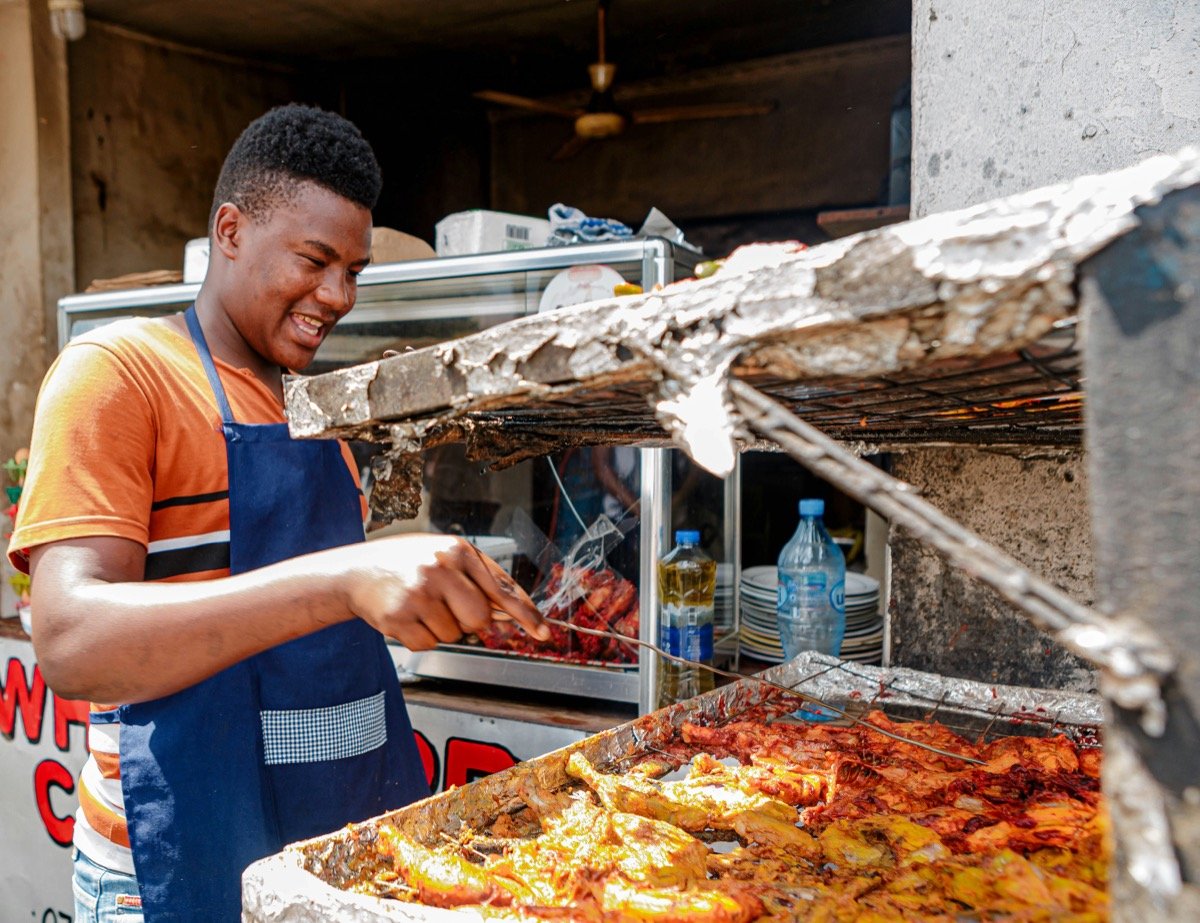
Dar es Salaam feeds itself well and cheaply. It is a city where the Indian Ocean fish market is one block from the city centre, where a neighbourhood nyama choma shack serves better grilled goat than most mid-range restaurants, and where the legacy of Arab, Indian, and Swahili trade routes produces a coastal cuisine that is genuinely worth seeking out. The trick is knowing where to look.
Kivukoni Fish Market: The Starting Point
The fish market at the Kivukoni waterfront is the single best food experience in Dar es Salaam. Arrive between 06:00 and 09:00. The market runs along the harbour adjacent to the ferry terminal - noise, ice, and fish smell build from dawn.
What you will see:
- Long tables spread with the overnight catch: yellowfin tuna, red snapper (changu), kingfish (ngisi), parrotfish, red crab, octopus (pweza), and squid
- Women vendors weighing fish and negotiating prices at rapid speed
- Charcoal grills on the street outside cooking fish to order for TZS 5,000–15,000 per portion
Eating at the market: A whole grilled red snapper with ugali and coconut chutney costs approximately TZS 8,000–15,000 depending on the fish size. Buy your fish from the market, hand it to one of the grill-women on the street outside, and they will cook it for a service fee of TZS 2,000–3,000. This is the cheapest and freshest seafood in the city.
Kariakoo: The Working City’s Lunch
The Kariakoo neighbourhood - centred on the main market and stretching through the streets around Tandamuti, Msimbazi, and Lindi Streets - is where most working Dar es Salaam residents eat lunch.
What to order:
- Pilau and biryani: Several restaurants in Kariakoo specialise in biryani - rice slow-cooked with spiced meat (chicken, beef, or goat) and finished with fried onions and dried fruit. A full portion: TZS 8,000–15,000. The biryani in this area reflects the city’s large Indian-Muslim community.
- Wali wa nazi with samaki: Coconut rice with grilled fish - widely available in the market area for TZS 6,000–12,000.
- Chipsi mayai: Every second block has a stall. TZS 3,000–5,000.
- Mchuzi wa bamia: Okra stew served with ugali - TZS 5,000–8,000. One of the best Swahili vegetable dishes.
Recommended area: The streets between Kariakoo Market and Msimbazi Street have the highest density of well-regarded local lunch joints. Walk in, see what is cooking, and follow the queues.
Msasani and Oysterbay: Mid-Range and International
The peninsula north of the city centre is Dar’s most affluent residential and dining district. Here you will find:
Waterfront Seafood Restaurants
Several restaurants on the Msasani waterfront serve fresh catch with Indian Ocean views. Fish grilled whole with garlic butter and served with chips or rice: TZS 35,000–65,000 for a full meal. Lobster when in season: from TZS 60,000 per portion. The quality varies - look for places that show the fish at the table before cooking.
Indian and Swahili Fusion
The Indian Ocean trade connections mean Dar has a genuine Indo-Tanzanian cuisine distinct from either pure Indian or pure Swahili cooking. Look for:
- Prawn masala: prawns cooked in a tomato-onion base heavy with cumin and coriander - TZS 30,000–50,000
- Fish tikka: marinated fish grilled in a tandoor - TZS 25,000–40,000
- Dal and roti: widely available at lunch, TZS 10,000–20,000
Ethiopian Restaurants
Dar has a notable Ethiopian expat community, and several restaurants in the Msasani area serve injera-based meals. Addis in Dar (see our restaurant guide) is the most established.
Nyama Choma: Evening Culture
Magomeni and Kinondoni
From around 18:00 onwards, the residential neighbourhoods of Magomeni and Kinondoni come alive with nyama choma. These are not restaurants - they are corrugated-iron shacks with charcoal grills, plastic garden furniture, and coolers of cold Kilimanjaro beer. The atmosphere is convivial, the food is simple, and the goat is excellent.
How to order nyama choma correctly:
- Ask to see the available cuts (ribs, chops, leg)
- Order by the kilo - budget TZS 25,000–35,000 per kg for good-quality goat
- Specify if you want it well done (most locals do - 45 minutes over good coals)
- It arrives with a mound of ugali, kachumbari, and sometimes a cabbage salad
A half-kilo of ribs with ugali and one round of drinks: approximately TZS 30,000–45,000 total. This is dinner for two if you both eat moderately.
Seafront Choma (Coco Beach Area)
Less atmosphere than the residential neighbourhoods, but closer to the waterfront. Vendors at the Coco Beach area grill fish and chicken from the afternoon. Weekends are lively with families and young people; weeknights quieter. Grilled whole chicken: TZS 15,000–25,000.
Breakfast in Dar
The local option: Any street near a market or bus stand will have a woman selling hot mandazi from a basket (TZS 200–500 each) and a small tea shack selling chai (TZS 500–1,000). Total cost: TZS 1,500–3,000 for a filling morning start.
Mid-range: The cafés around Msasani and Sea Cliff Village serve proper espresso (made with Tanzanian arabica), fresh juices, and egg dishes. A full café breakfast: TZS 18,000–35,000.
A Dar es Salaam Food Day
For a day of good eating in Dar:
Morning: Kivukoni fish market (06:30–09:00). Grilled fish breakfast for TZS 8,000–12,000. Walk around the market, then take a tea at a nearby stall.
Lunch (12:00–14:00): Kariakoo area for pilau or biryani with kachumbari (TZS 8,000–15,000) or chipsi mayai with salad (TZS 4,000–6,000).
Afternoon coffee: Café in Msasani area (TZS 6,000–10,000 for a proper espresso with Kilimanjaro beans).
Evening: Nyama choma in Kinondoni with cold Kilimanjaro beer (TZS 35,000–55,000 for two people with drinks).
Total for a full day’s excellent eating: TZS 65,000–100,000 (approximately USD 25–38). This is one of the most affordable cities for quality food in East Africa. Browse Dar es Salaam food tours to explore the city’s dining scene with a local guide.
Seasonal Notes
Peak fresh seafood: June–October (dry season) when calmer seas allow fishing boats further offshore. Prawns (kamba) and squid are at their best.
Ramadan timing: Dar has a significant Muslim population. During Ramadan, most local restaurants operate on reduced hours (many close from dawn to sunset). At iftar (sunset), speciality dishes appear - heavily spiced pilau, sambosas, dates, and coconut-milk desserts. Experiencing iftar in Kariakoo is one of the city’s best food moments.
Avoid: Pre-cooked food sitting in windows without refrigeration. In the midday heat, food standing for more than two hours poses genuine risk. This is not a concern at the fish market (high turnover) or at nyama choma shacks (cooked fresh), but applies to some lower-end roadside stalls.
For named restaurant picks - mid-range addresses in Msasani, the best nyama choma bars in Magomeni, and coffee shops by neighbourhood - see our Dar es Salaam restaurant guide. Get an eSIM for Tanzania before arriving in Dar - it provides instant mobile data for maps, ride apps, and finding restaurants without hunting for a local SIM card.