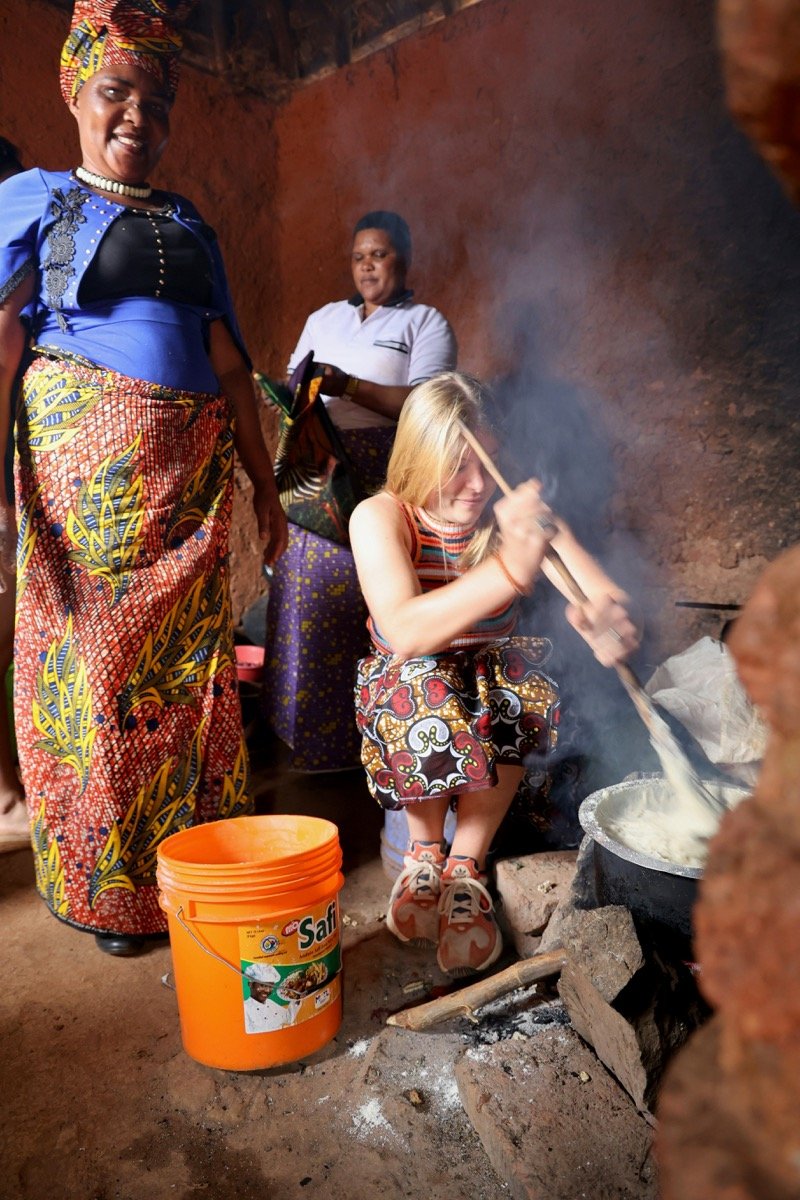
Tanzanian food is a product of its geography - the country spans savanna, highland plateau, Indian Ocean coast, and the great lakes. Each zone has shaped what people grow and eat. The mainland staple of ugali and grilled meat contrasts sharply with the aromatic, spice-laden coastal cooking of Zanzibar and Dar es Salaam, which spent centuries at the centre of the Indian Ocean trade routes. Understanding both is the key to eating well across the country.
The Staples
Ugali
The foundation of the Tanzanian diet. Ugali is made by cooking white maize flour in boiling water, stirring constantly until it forms a stiff, smooth dough. The result is something between mashed potato and polenta in texture - dense, filling, and almost tasteless on its own. That is the point: ugali is a vehicle for stew, greens, or grilled meat.
Eating it correctly: tear off a small piece with your right hand, press a hollow in it with your thumb, and use it to scoop up stew or vegetable sauce. Every street restaurant on the mainland serves it. Cost: TZS 2,000–5,000 as part of a full plate. Ugali made from cassava flour (ugali wa muhogo) is common along the coast and in the south; sorghum ugali is found in the Dodoma and central plateau regions.
Wali (Rice)
The coastal equivalent of ugali. Wali wa kawaida is plain boiled rice; wali wa nazi is cooked in coconut milk and is one of Tanzania’s best everyday dishes - fragrant, slightly sweet, and excellent with a fish curry or grilled octopus. Wali wa nazi is the rice to order along the coast and in Zanzibar.
Mkate (Bread)
The Indian Ocean trade left a legacy of leavened and unleavened breads across Tanzania. Chapati (flatbread made from wheat flour and cooked on a dry pan) is eaten at most meals as an ugali substitute. Mandazi (deep-fried dough, slightly sweet, triangular) is the standard breakfast pastry across the country, sold from street baskets for TZS 200–500 each.
Grilled Meat: Nyama Choma Culture
Nyama choma - grilled meat - is the social food of Tanzania. It is less a dish than an event: friends gather at an open-air choma shack in the evening, beer or soda is ordered, and a rack of goat ribs or a whole chicken goes on the charcoal grill. The meat is unseasoned beyond salt; the point is the quality of the animal and the heat of the coals.
What to order:
- Mbuzi (goat): The standard nyama choma meat. Ribs, chops, or offcuts. Order by the kilo (approximately TZS 20,000–35,000 per kg depending on cut and location).
- Ng’ombe (beef): Cheaper than goat in most places; less common on the choma grill.
- Kuku (chicken): Whole or half, always grilled longer than you expect - properly done nyama choma chicken takes 45 minutes.
- Nguruwe (pork): Available in areas with a significant Christian population (western Tanzania, some parts of Dar es Salaam). Not available in Muslim-majority areas.
Nyama choma is always served with ugali and kachumbari (a raw salad of diced tomato, onion, coriander, and chilli). The kachumbari provides the acid that cuts the fat of the meat.
Street Food
Chipsi Mayai
Literally “chips and eggs” - this is Tanzania’s most loved street food. French fries (cooked soft, not crispy) are folded into a thick egg omelette and fried until the base is slightly caramelised. Served with kachumbari. Found everywhere from market stalls to roadside kiosks. Price: TZS 2,500–5,000. A masterclass in simple food done right.
Muhogo wa Nazi (Cassava in Coconut)
Cassava boiled or grilled, then dipped or soaked in freshly grated coconut and a squeeze of chilli. A classic Swahili coast snack, best at beach-side stalls in Dar es Salaam or Stone Town. TZS 1,000–2,000 per portion.
Urojo (Zanzibar Mix)
This Zanzibari street food staple is a sour, tangy broth soup base (tamarind and mango) poured over cassava, potato bhajis, fried cassava chips, and hard-boiled egg. Sellers at the Forodhani night market serve it for TZS 3,000–5,000. It sounds chaotic but the balance of textures and the sourness of the broth make it immediately addictive.
Vitumbua
Rice and coconut milk pancakes, cooked in a special pan with hemispherical moulds to produce small, round, slightly crispy cakes. Sold at breakfast from hand-carried pans. TZS 200–500 each. Common in coastal areas.
Mishkaki
Marinated meat skewers - beef or goat, flavoured with garlic, ginger, and cumin - grilled over charcoal and served with bread or rice. TZS 1,000–2,000 per skewer. Found at street grills from late afternoon onwards.
Coastal and Swahili Cuisine
Pilau Rice
One of Tanzania’s most important dishes and a direct legacy of Swahili-Arab trade routes. Pilau is basmati rice cooked with a spice paste of cardamom, cloves, cinnamon, black pepper, and cumin - often with meat (chicken or beef) stirred in and the whole dish finished in stock. The result is fragrant, rich, and complex. In Zanzibar, pilau is served at celebrations; on the mainland, it is available at most coastal restaurants.
Biryani is a similar but richer version, with the spiced rice layered with slow-cooked meat and sometimes dried fruit. The Dar es Salaam biryani, influenced by the city’s Indian community, is among the best in East Africa.
Samaki (Fish Dishes)
Fish is central to coastal Tanzanian cooking. The most common preparations:
- Samaki wa kupaka: Fish marinated in coconut milk and tamarind, then grilled or baked - one of the defining Zanzibari dishes
- Samaki wa nazi: Fish simmered in coconut milk with tomatoes and spices - rich, aromatic, excellent over wali wa nazi
- Kamba (prawns): Grilled, curried, or cooked in butter and garlic; most abundant in June–October
- Pweza (octopus): Slow-cooked or grilled; the octopus at Forodhani market in Stone Town is a benchmark
Mchuzi wa Bamia (Okra Curry)
A dark, slightly mucilaginous curry of okra with tomatoes, onion, and coconut milk. A Swahili staple and one of Tanzania’s best vegetable dishes. Usually served over rice.
Drinks
Chai (Tea)
The national drink. Tanzanian chai is brewed strong, then milk and sugar are added directly in the pot. It is served hot, sweet, and milky - closer to British builder’s tea than to any speciality version. Cost: TZS 500–1,000 per glass everywhere.
Kilimanjaro Arabica Coffee
Tanzania grows some of Africa’s finest coffee on the slopes of Kilimanjaro and Mount Meru. The beans have a bright, winey acidity and moderate body. Despite this, most Tanzanians drink instant coffee (Africafé is the domestic brand). To get proper Kilimanjaro arabica, buy whole beans from the Cultural Heritage Centre in Arusha, the Moshi market, or the coffee farm tours; or order filter coffee at Moshi’s Kilimanjaro Coffee Lounge.
Pombe (Local Beer)
Kilimanjaro Premium Lager and Safari Lager are the dominant commercial beers. Traditional pombe (fermented grain beer) and mbege (banana beer, specific to the Chagga of Kilimanjaro) are consumed in rural communities but rarely in restaurants. A Kilimanjaro in a local bar: TZS 3,000–4,000. In a Msasani restaurant: TZS 5,000–8,000.
Fresh Juice and Coconut Water
Fresh coconut (madafu) - green coconuts split open and sold for the juice inside - are ubiquitous on the coast at TZS 1,000–2,000. Fresh mango, passion fruit, and pineapple juice pressed to order: TZS 2,000–4,000 at most cafés.
Where to Eat: A Quick Regional Guide
| Region | Best local food | Where to find it |
|---|---|---|
| Zanzibar/Stone Town | Pilau, samaki wa kupaka, Zanzibar pizza | Forodhani market, local restaurants |
| Dar es Salaam | Chipsi mayai, nyama choma, biryani | Kariakoo area, Kivukoni fish market, Msasani |
| Arusha | Nyama choma, coffee, Highland vegetables | Market area, nyama choma bars |
| Moshi | Chagga dishes, plantain, mountain coffee | Coffee farms, market restaurants |
| Dodoma | Ugali with goat, local wine grapes | Local restaurants |
Food Safety
Eat at restaurants with high turnover. The risk of food-borne illness drops significantly if you choose busy places where food is cooked fresh rather than reheated. In street food situations: fried food freshly cooked is safer than pre-cooked food sitting out. Raw salads (kachumbari) are generally safe at reputable places because the high acidity of tomato and the chilli acts as a partial antimicrobial - but be cautious at low-turnover roadside stalls.
Water: always bottled or boiled. Do not add ice unless you are at a mid-range or higher restaurant that explicitly filters water.
Browse Tanzania food tours and cooking experiences - several operators in Arusha, Dar, and Zanzibar offer genuine Swahili food experiences. Travelling to Tanzania for the food and culture? Compare flights to Tanzania to find the best international connections.