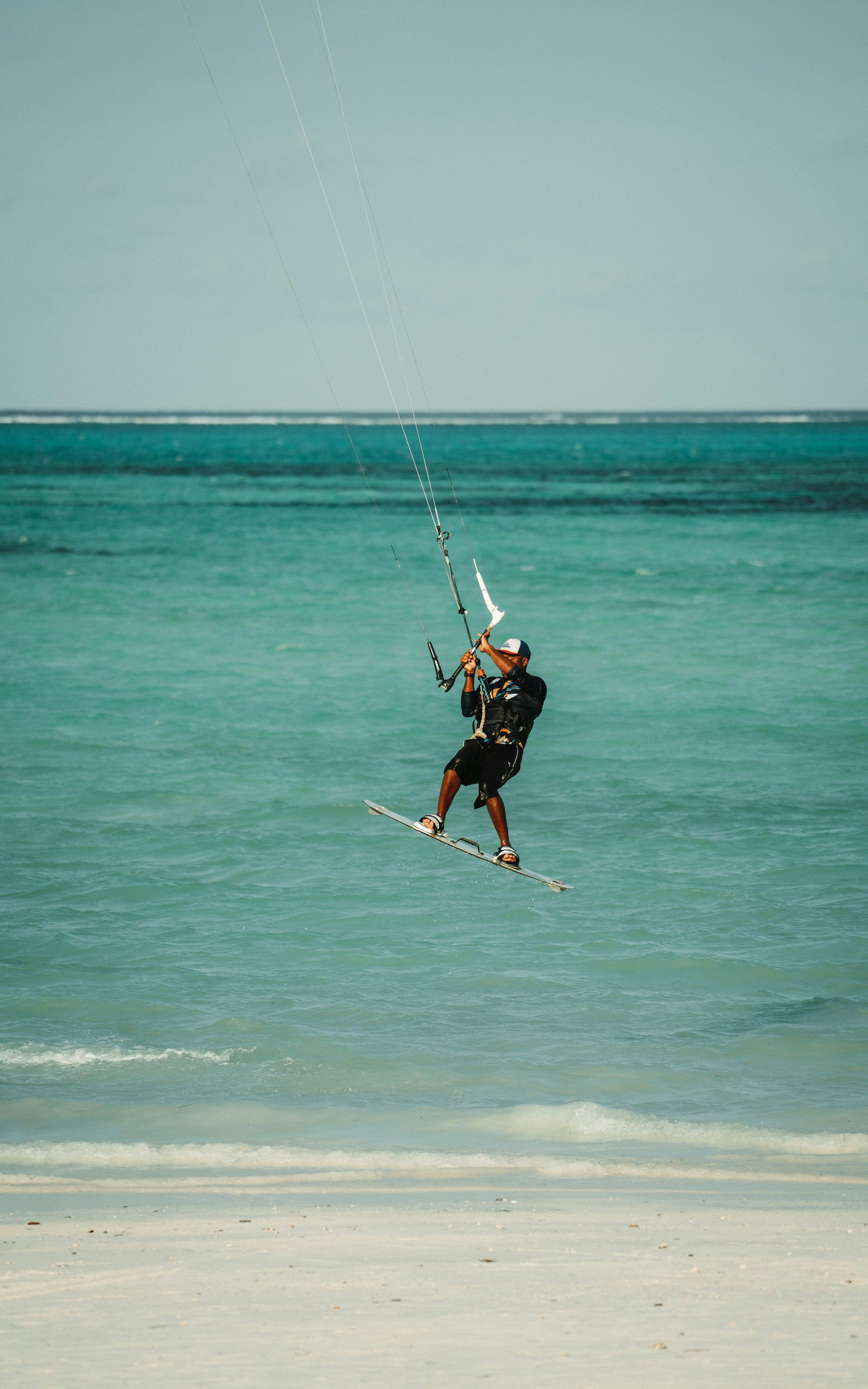
Paje is a small village on Zanzibar’s southeast coast that has spent the last fifteen years becoming one of East Africa’s most concentrated kitesurfing hubs. What brought the kiters here — and keeps bringing them back — is a wide, shallow lagoon inside the reef, trade winds that blow from two consistent seasonal directions, and water temperatures that hover around 26 to 28 degrees Celsius year-round. For a sport that requires wind, flat water, and warmth, Paje offers all three simultaneously.
The village itself has transformed around the sport: beachside schools, guesthouses, restaurants, and repair shops line the shoreline road from Paje south to Bwejuu. The atmosphere is relaxed rather than resort-polished — this is a kite beach, not a five-star beach club, and most visitors are here for the sport rather than the sunbeds.
The Wind and Water Conditions
The Zanzibar Channel sits in the Indian Ocean monsoon belt, which generates two reliable seasonal winds. Understanding which is blowing determines what the riding is like.
Kusi (Southeast Trade Winds): June to October The kusi is the stronger and more consistent of the two seasons. Wind speeds average 20 to 28 knots during July and August — strong enough for experienced riders to generate serious speed and jump height, and consistent enough that beginners can progress quickly through lesson sequences. The wind comes from the southeast, which pushes riders toward the shoreline (onshore/side-on), making it safer for beginners who get dragged downwind.
Kaskazi (Northeast Trade Winds): December to February The kaskazi is lighter and more variable — typically 15 to 22 knots, with some days dropping below the minimum useful wind speed. It is still kiteable and good for learning, but less predictable than the kusi. Water conditions inside the lagoon remain flat. December through January sees the beach busy with European winter escape visitors.
Off-Season: March to May and November The long rains (March to May) and short rains (November) bring irregular winds, rain squalls, and periods of flat calm. Schools typically operate at reduced capacity and conditions are not suitable for independent riding. Some schools close during April and May.
Paje Beach Operators
The following schools are among the established operators on Paje beach as of 2026:
Zanzibar Kite Center (ZKC) — one of the longer-running schools on the beach, IKO-certified instructors, beginner courses from approximately USD 380 for 12 hours. Equipment rental from USD 55 per day. Located at the main Paje junction beachfront.
Dunia Kitesurfing — smaller operation with strong instruction reputation for nervous beginners, maximum two students per instructor. Beginner course approximately USD 420 for 12 hours. Also offers downwinder trip guides to Jambiani and Bwejuu.
Reef & Kite — combined kite school and accommodation, convenient for those doing multi-day courses. IKO Level 1 and 2 instruction, beginner course from USD 360 for 9 hours. Board rental separately from USD 20 per day.
Paje by Night — primarily a beach bar and accommodation but runs informal lessons for guests and refers to certified partners for formal courses. Good for getting a feel for the scene before committing to a full course.
Most schools accept walk-in bookings but advance booking for the kusi high season (July to August) is strongly recommended. Schools in Paje are concentrated within a 2 km stretch of beach and it is easy to compare prices and instructors in person on arrival. You can also browse Zanzibar water sport experiences on GetYourGuide to read verified reviews before committing to a school.
Beginner Kite Courses: What to Expect
A standard IKO-certified beginner course runs 9 to 12 hours over 3 to 4 days. Structure varies slightly by school but typically follows this sequence:
Day 1 (2 to 3 hours): Beach training with a trainer kite — a small (2 to 3 m) kite used to learn the wind window, kite control, and body dragging without a board. No swimming required; trainer kite sessions happen on the sand and in very shallow water.
Day 2 (3 hours): Body dragging in the lagoon with a full-size kite. You learn to control the kite with one hand while swimming in the direction you choose — a critical safety skill. No board yet.
Day 3 to 4 (4 to 6 hours): Board starts. Learning to stand up, edge the board, and ride in a straight line. Most students achieve their first proper run during day 3 or 4; some need a day 5 depending on wind conditions and athletic background.
The lagoon at low tide is ideal for these early stages: standing depth throughout means a fall is a walk, not a swim.
Getting to Paje
Paje is 55 km southeast of Stone Town — approximately 1 to 1.5 hours by road. Shared dala-dala minibuses from Stone Town central market run to Paje for approximately TZS 3,000 to 4,000 per person (under USD 2), but take 2 to 2.5 hours with all stops. A private taxi from Stone Town costs approximately USD 35 to USD 50 and takes around 60 minutes. Most accommodation in Paje can arrange airport transfers from Zanzibar Airport for approximately USD 25 to USD 35.
If you are based in Stone Town, Paje is an easy day trip on a non-kite day — the beach and lagoon are worth seeing even for non-riders, and snorkelling from the reef edge is excellent.
Accommodation in Paje
Kitesurfers typically base themselves at beach guesthouses within walking distance of the schools. Budget options start from approximately USD 30 to USD 50 per night for a basic en-suite room. Mid-range guesthouses with pools — such as Paje by Night, Hakuna Majiwe, and Kinazi Upepo — run from approximately USD 80 to USD 140 per night. Booking in advance for July and August is essential: the small village fills up quickly during peak kusi season.
Beyond Kitesurfing
Paje and the surrounding coastline also offer excellent snorkelling from the reef at high tide, and Zanzibar island has a full range of other water activities including diving at Mnemba Atoll (day trip from nearby Bwejuu), and the famous sunset dhow cruises from Stone Town a short drive north. Most kitesurfers use Paje as a base and day-trip to Stone Town for culture and dining between sessions.