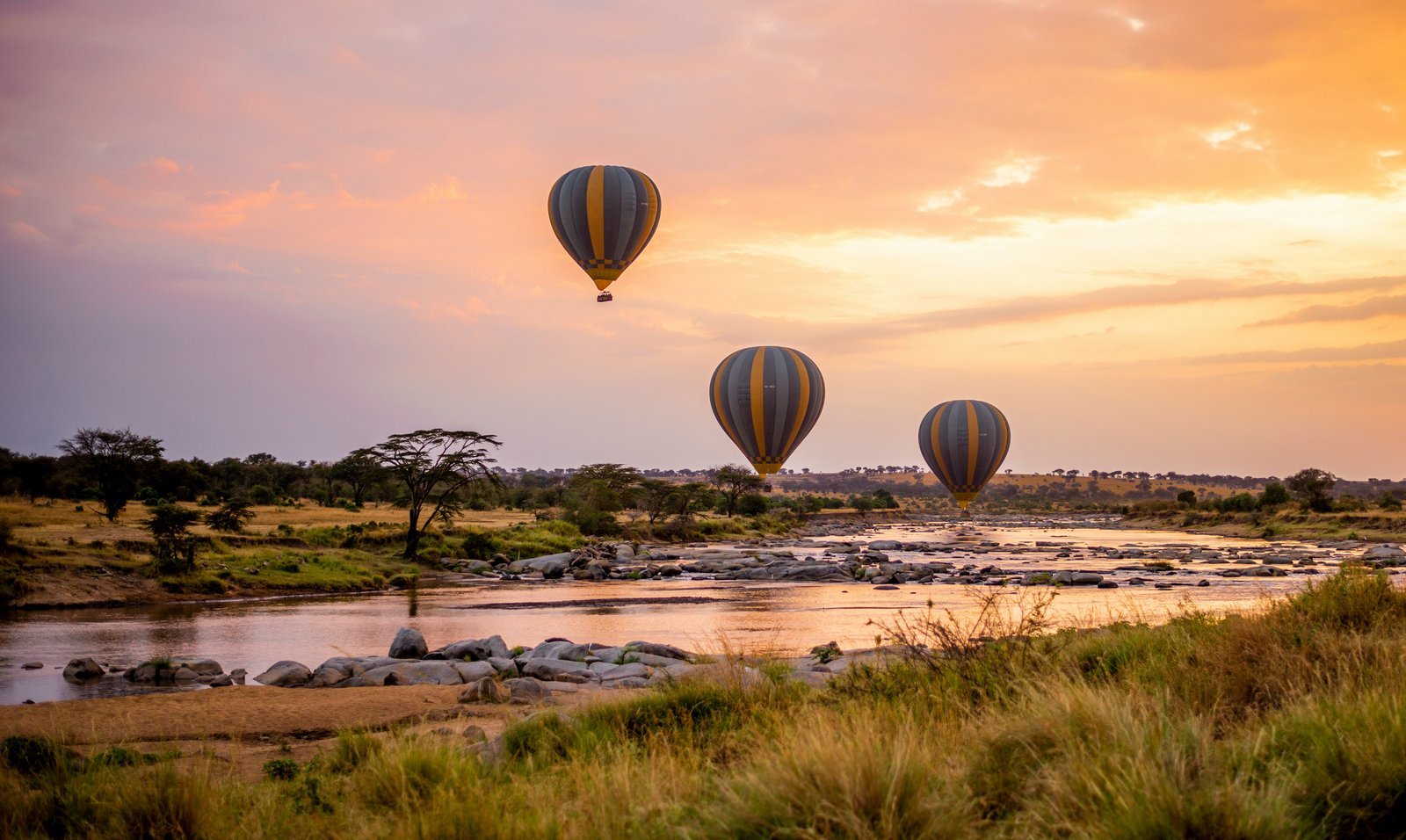
Watching the sun rise over the Serengeti from 1,500 feet is one of those travel moments that stays with you for years. The plains below shift from charcoal to copper as the balloon lifts silently, no engine noise, just wind and the occasional burst from the overhead burner. Below, the grass stretches in every direction, broken by acacia silhouettes and the distant movement of wildlife that has not noticed you are there.
A hot air balloon flight over the Serengeti lasts around 60 minutes. That hour is worth every planning step it takes to arrange.
What Happens on a Balloon Safari
Departures happen before sunrise, typically around 5:30 to 6:00 am. Your lodge or camp arranges the transfer to the launch site. Once inflated, the balloon carries six to 16 passengers at around 150 to 300 metres above ground, drifting on prevailing winds across the plains.
The pilot navigates by altitude changes rather than a fixed course, which means no two flights are identical. On a calm morning you might hover just above the tree canopy; at other times the balloon climbs high for panoramic views of the crater escarpment or the Grumeti River corridor.
After landing, a champagne bush breakfast is laid out in the field, with tables, linen, and hot food brought in by the support vehicle. Many flights also include a certificate and a short wildlife drive back to camp.
Balloon Safari Operators
Serengeti Balloon Safaris is the longest-established and most frequently booked operator. They run daily flights from three zones: the central Serengeti (near Seronera), the western corridor (Grumeti area), and the northern Serengeti (Kogatende, near the Mara River). Prices start at approximately USD 599 per person as of 2026, inclusive of the champagne breakfast and transport from nearby camps.
Miracle Experience Balloon Safaris operates flights from several launch sites in the central Serengeti. Prices are typically slightly lower, from around USD 480 per person, making this a popular option for travellers on tighter budgets who still want the full experience.
Coastal Aviation and other regional charter companies sometimes bundle balloon flights with fly-in safari packages. These are worth checking if you are already paying for a private flight into the Serengeti, as the combined pricing can be competitive.
Booking direct through an operator is usually cheaper than booking through a lodge or tour company, though lodges often handle all logistics and communication for no extra fee.
Best Season for a Balloon Safari
Balloon flights operate year-round in the Serengeti, but the experience varies significantly by season.
June to October is the most popular window. The long dry season concentrates wildlife around water sources, vegetation is shorter, and visibility is excellent. The northern Serengeti (Kogatende) sees the Great Migration crossing the Mara River during July and August, making those months the most dramatic for aerial views of large herds.
December to March brings the calving season to the southern Serengeti and Ndutu area. Seeing thousands of wildebeest calves from the air, with predators circling at the edges, is a different kind of spectacle. Flights run from the central Serengeti launch sites during these months.
April and May are the long rains. Flights still operate but are more likely to be delayed or cancelled due to cloud cover. If you are visiting during this period, build flexibility into your schedule.
Flight Zones and What You Will See
Central Serengeti (Seronera): Year-round resident wildlife including lion prides, cheetah, leopard, and elephant. The Seronera River valley is particularly productive. This is the most accessible launch site.
Western Corridor (Grumeti): Hippo pools and the Grumeti River crossing during June and July. Fewer tourists than the central area. Tented camps in this zone can arrange balloon departures directly.
Northern Serengeti (Kogatende): The migration crossing zone. July and August flights here offer the best chance of seeing wildebeest in the Mara River crossing, from a perspective that no game drive can replicate.
What to Wear and Bring
Mornings on the Serengeti are cold at altitude, typically 10 to 15 degrees Celsius at takeoff, warming to 25 degrees or more by 9 am. Dress in layers you can remove. Avoid loose scarves or wide-brimmed hats that can catch the burner blast.
Bring a camera with a wide-angle or standard zoom lens. Telephoto lenses are useful for close-up wildlife shots during the post-landing game drive, less so during the flight itself. Most smartphones produce excellent results in the soft morning light.
Booking Tips and Practical Notes
- Book directly with the operator at least four to six weeks before your intended date during July to September. Flights fill weeks in advance. You can also compare Serengeti balloon safari options on GetYourGuide to read verified guest accounts from recent passengers.
- Confirm your weight and any mobility concerns when booking. The basket requires a step-in entry point at roughly knee height.
- Balloon safaris are weather-dependent. Operators make a go/no-go call on launch morning. If a flight is cancelled, reputable operators reschedule or refund in full.
- Your lodge in the Serengeti will typically arrange the 5 am pickup. Coordinate the logistics with camp staff the evening before.
- Children must be at least 7 years old, with parental supervision required for anyone under 15.
Combining with a Wider Safari
A balloon flight fits naturally into a multi-day Serengeti circuit. Most travellers schedule it on day two or three, once they have had a game drive orientation from ground level. Combining a balloon morning with an afternoon game drive, sunrise from the air and sunset on the plains, is one of the more complete single-day wildlife experiences available in East Africa.
The flight also pairs well with a Ngorongoro Crater day trip, which can be scheduled as a separate day before or after your time in the Serengeti. Most standard northern circuit itineraries cover both parks in five to seven days.
Is It Worth the Cost?
For the majority of visitors who do it, yes. The Serengeti is extraordinary from ground level. From 300 metres, it becomes something else entirely: the scale of the plains becomes comprehensible in a way it never quite does from a vehicle. An hour of drifting silence over one of the world’s great wildlife landscapes, followed by champagne in the grass, is not easily forgotten.
The cost is real, from approximately USD 450 to 600 per person depending on operator and season. If your budget has room for one splurge on a Tanzania safari, a balloon flight over the Serengeti is a strong candidate.
For a full breakdown of what happens on the flight, departure zones, what to pack, and practical logistics, see our Tanzania hot air balloon safari guide.