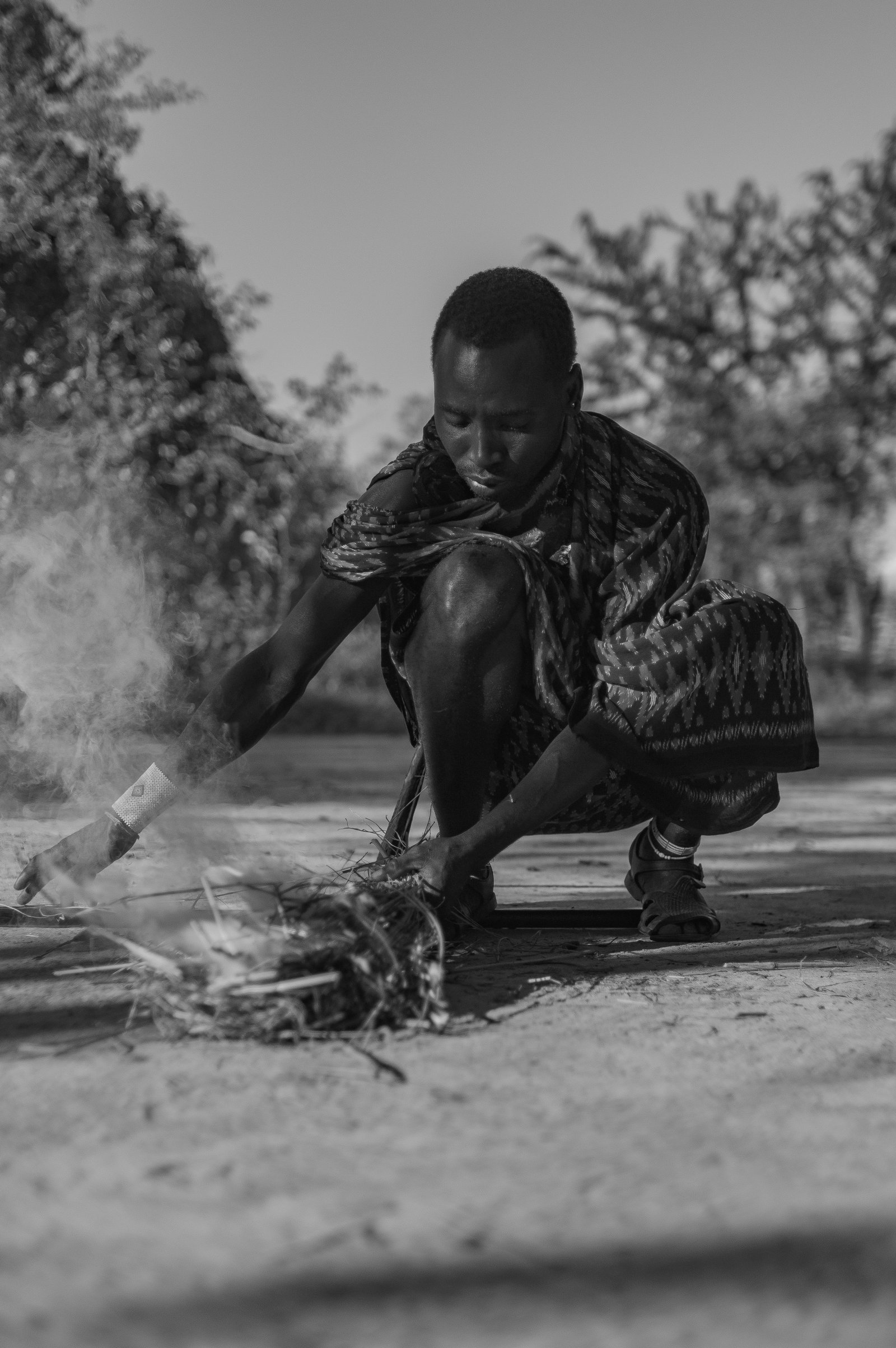
Lake Eyasi is a shallow alkaline lake on the floor of the Rift Valley, roughly 100 kilometres southwest of Ngorongoro — a landscape of dust, thorn scrub, and cracked salt flats that looks at first glance like the end of the world. Around the lake’s margins, in small temporary camps of grass and bark shelters, live the Hadzabe: one of the last fully nomadic hunter-gatherer peoples on earth. Visiting them is an experience that sits in a different category from any other safari activity in Tanzania.
This is not a cultural performance. Spending a morning with a Hadzabe hunting party means walking through thorn scrub before dawn with men who communicate in a click language older than any other known to linguistics, watching them stalk baboon or impala with hand-carved bows, and observing fire being started from two sticks in under three minutes by someone who could, if required, survive indefinitely without any of the equipment you are carrying. It is one of the most genuinely illuminating things available to do in East Africa.
About the Hadzabe
The Hadzabe speak a language characterised by consonantal clicks — a feature shared with the Khoi-San peoples of southern Africa, though the two groups are geographically distant and linguistically distinct. Genetic studies place the Hadzabe among the most ancient human lineages on earth; their ancestors have lived in the Lake Eyasi basin for at least 40,000 years and possibly much longer.
The current Hadzabe population is estimated at 1,000 to 1,500 individuals. Of these, a few hundred live fully nomadically, hunting game with bows and arrows, gathering wild fruits and tubers, and moving their grass shelters as game patterns and water sources shift. Others have settled in more permanent communities around Mangola and Domanga villages. Most tourism visits go to the semi-nomadic camps, where the traditional lifestyle remains largely intact.
The Hadzabe have no chiefs or formal hierarchy — decisions are made by consensus, and anyone who attempts to accumulate more resources than they need is expected to share. Private property in the Western sense does not exist. Meat from a hunt is distributed through the entire camp by established social rules.
The Morning Hunt Experience
Most Lake Eyasi visits follow a similar structure. Your guide arrives at a Hadzabe camp before or at dawn, when the hunting party is preparing to leave. A morning hunt typically lasts 2 to 4 hours and covers between 5 and 15 kilometres on foot through thorn scrub, rocky outcrops, and dry riverbed terrain.
The Hadzabe carry hand-carved wooden bows and arrows tipped with animal bone or, increasingly, salvaged metal. The arrows used for large game (impala, baboon, warthog) are treated with a plant-derived poison — a mild cardiac glycoside that slows prey after a hit. Arrows for birds and small game are unpoioned.
Whether the hunt results in a kill varies. On some visits, the hunters return with game; on others, they find little. This is not a staged performance with a guaranteed outcome, which is part of what makes the experience honest. If a kill is made, you witness the butchering and distribution — a rapid, practised process that leaves almost nothing wasted.
After the hunt, the group typically returns to camp. Women and children are gathering wild berries, baobab fruit, and tubers while the hunters are out. A fire is often lit using the hand-drill technique — the friction method is fast and impressive, and Hadzabe children as young as 8 or 9 can demonstrate it. Honey is a staple of the diet; finding a bee nest in a tree hollow and smoking it out to extract comb is another activity sometimes demonstrated.
Getting to Lake Eyasi
Lake Eyasi is approximately 100 kilometres from Ngorongoro Crater and 200 kilometres from Arusha. The road from the main Ngorongoro highway drops steeply off the Rift escarpment into the lake basin — a 45-minute descent that requires a 4WD during and after the rainy season. In the dry season, a high-clearance 2WD can manage the main track, but the final kilometres to some Hadzabe camps require 4WD regardless.
From Arusha: Full-day trip covers roughly 4 hours of driving each way plus 3 to 4 hours at the lake. Long day; most operators recommend combining with a night in the area. Several basic guesthouses in Karatu (at the top of the escarpment near Ngorongoro Gate) serve as a practical base.
Combined with Ngorongoro itinerary: The most common way to visit Lake Eyasi is as a day excursion from a Karatu-based lodge or Ngorongoro camp. This adds approximately 3 to 4 hours to a day otherwise spent at the Ngorongoro Crater, making for a very full schedule. More relaxed is a dedicated Lake Eyasi night in Karatu or at the lake itself, inserting the visit between two safari days.
Lake Eyasi-based accommodation: A few small camps operate around the lake, including Tindiga Tented Camp and Lake Eyasi Lodge — both positioned to facilitate dawn departures for the Hadzabe morning hunt. Rates from approximately USD 150 to USD 300 per person per night full board.
Operators and Booking
Reputable Arusha-based operators offering Lake Eyasi and Hadzabe programmes:
Africa Cultural Tourism (Arusha) — specialise in community-focused cultural visits including Lake Eyasi. Operate with a fixed Hadzabe community guide who has long-term relationships with specific camps. Day trip from approximately USD 180 per person including transport and community contribution.
Dorobo Safaris — long-standing cultural tourism pioneer, known for ethical community engagement. Offer Lake Eyasi as part of longer walking itineraries. Worth enquiring even if you are on a standard safari circuit.
Uhuru Tours & Safaris (Arusha) — Lake Eyasi day trip from approximately USD 150 per person departing Arusha at 05:30. Shorter time at the lake (2 to 2.5 hours with Hadzabe) but affordable for those on a budget.
When booking, confirm: the maximum group size (should be 6 or fewer), how the community contribution is paid (directly to the camp rather than through the operator), and whether your specific guide has an existing relationship with a camp rather than arriving cold. You can also browse cultural tours and northern circuit day trips on GetYourGuide to compare operator ratings and inclusions before committing.
Combining with Other Northern Circuit Destinations
Lake Eyasi sits in a natural triangle with Ngorongoro Crater and the Karatu highlands. A logical 3-day extension from Arusha covers: Day 1 drive to Karatu, afternoon at Lake Eyasi with Hadzabe; Day 2 full day Ngorongoro Crater game drive; Day 3 morning in the Ngorongoro highlands then return to Arusha or continue to Serengeti. This gives maximum variety — cultural, geological, and wildlife — in a compact schedule.
The Datoga blacksmith community also lives around Lake Eyasi; some operators combine a Datoga metalwork demonstration with the Hadzabe visit. The Datoga are pastoralists who have traded metal arrow tips with the Hadzabe for generations — an encounter between the two communities is still common and provides additional context to the visit.