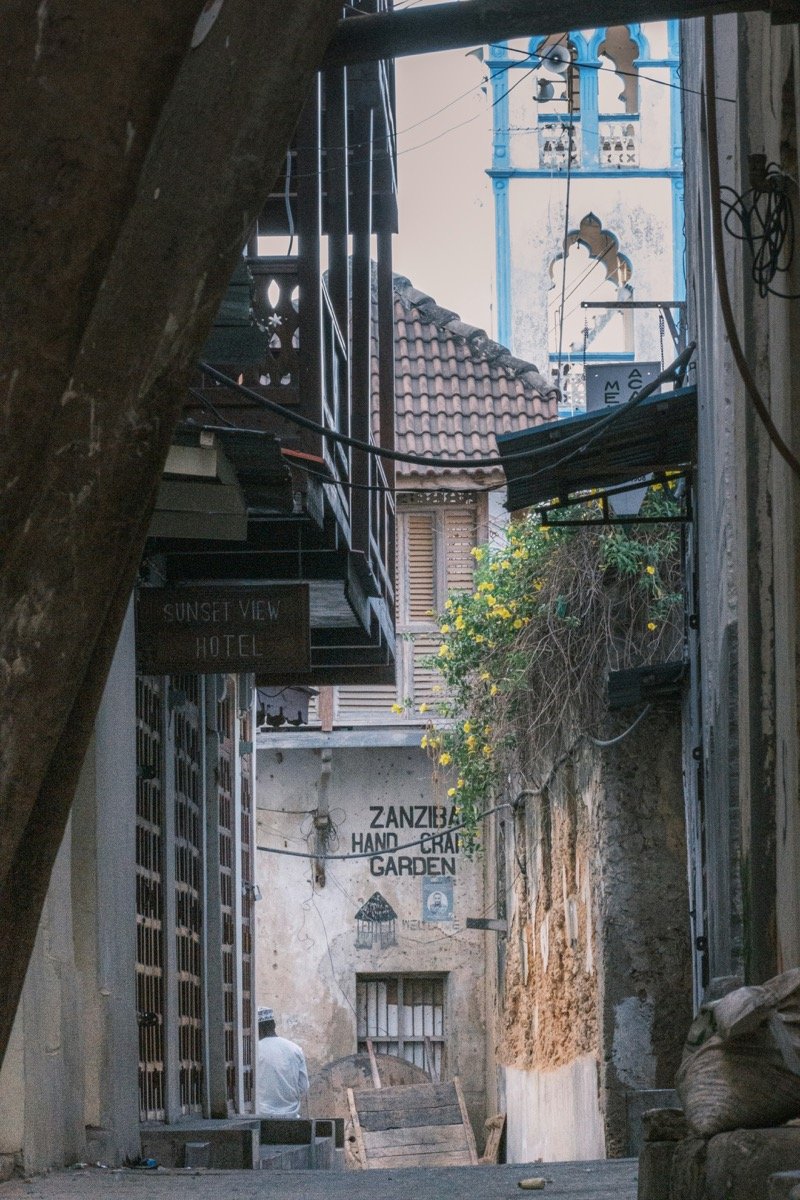
Stone Town is one of East Africa’s most layered historic cities. The UNESCO World Heritage old town is a physical record of six centuries of Swahili culture, Arab rule, Persian trade, Indian merchant settlement, and British colonial administration - all compressed into a tangle of narrow alleys, carved wooden doors, coral stone buildings, and waterfront warehouses. It is also the island of Zanzibar’s commercial and cultural capital, with a port, a fish market, mosques, Hindu temples, and a thriving street food scene.
Old Fort (Ngome Kongwe)
The most prominent landmark on the Stone Town waterfront, the Old Fort was built by Omani Arabs in the early 1700s on the site of a Portuguese chapel. The thick coral stone walls enclose an open courtyard now used for concerts, cultural performances, and a small market of stalls selling fabrics, paintings, and jewellery.
The fort itself is free to enter. An evening cultural performance (traditional Taarab music, ngoma drumming, or dance) is staged several nights per week - check at the entrance or with your accommodation for the current schedule. Performance tickets approximately USD 5–10 per person.
Search hotels in Zanzibar on Booking.com
House of Wonders (Beit el-Ajaib)
The House of Wonders was built in 1883 as the ceremonial palace of Sultan Barghash. At the time, it was the largest building in East Africa and the first in Zanzibar to have electric lights - hence its name. The building is currently under restoration, but the exterior with its multi-storey wrought-iron balconies and the old dock crane in front remain one of Stone Town’s most photographed views. Check current access status on arrival.
The Slave Trade History Sites
Slave Market and Memorial Church
Stone Town was the centre of East Africa’s largest slave trade until the British Navy forced abolition in 1873. The Anglican Christ Church Cathedral was built over the former slave market where up to 50,000 enslaved people were sold annually at peak trade. Beneath the cathedral, the original slave holding chambers - dark, narrow, and suffocatingly low - are preserved and open to visitors.
Entry approximately USD 5 per person (includes cathedral and chambers). A clear interpretive display in the chambers explains the trade’s scale and the role of British abolitionism. Open Monday–Saturday 09:00–17:00.
House of Slaves (Tippu Tip’s House)
Hamad bin Mohammed al-Murjebi, known as Tippu Tip, was the most powerful slave and ivory trader of 19th-century East Africa. His house on Suicide Alley in the old town is still standing and can be viewed from the street. The carved wooden doors and decorative stonework illustrate the wealth generated by the trade.
Forodhani Gardens Night Market
Every evening from around 18:00 to 22:30 (times vary; starts when vendors arrive and ends when they leave), the waterfront gardens fill with charcoal grills and cooking stations. The most photographed dish is Zanzibar mix - fried cassava chips, bhajis, chilli sauce, and tamarind piled on a tray for TZS 2,000–5,000. Other reliable stalls:
- Zanzibar pizza: A thin dough filled with egg, cheese, vegetables, and meat, folded and fried on a griddle. TZS 5,000–10,000 depending on fillings.
- Fresh grilled seafood: Octopus skewers, prawns, and fish - priced per stick, typically TZS 3,000–8,000 each. Negotiate if buying multiple.
- Sugarcane juice: Fresh pressed, TZS 1,000–2,000.
- Urojo (Zanzibar soup): A tangy, slightly sour soup with potato, bhaji, cassava, mango, and coconut - TZS 3,000–5,000.
Darajani Market (Central Market)
Open every morning from approximately 07:00–16:00, Darajani on Creek Road is where Stone Town does its daily shopping. The covered hall has a fish section (octopus, kingfish, red snapper, crab) at the back and a produce hall stacked with fresh cloves, cinnamon sticks, nutmeg, lemongrass, and pineapples. The surrounding streets have tailors, fabric sellers, and hardware shops.
Buy spices here rather than at tourist-oriented spice market stalls - prices are lower and the quality is the same. A good 100g bag of whole cloves, freshly dried: TZS 5,000–10,000.
Spice Tours
Zanzibar’s spice trade made it the richest port in the Indian Ocean in the 19th century. Full spice tours visit working farms north of Stone Town in the Kizimbani and Kindichi areas and include:
- Identifying cloves, cinnamon, nutmeg, vanilla, cardamom, turmeric, and black pepper on the tree or vine
- Tasting fresh fruit including jackfruit, starfruit, ylang-ylang, and breadfruit
- Traditional cooking demonstrations using the spices
- A lunch using the harvested spices (included in better tours)
Half-day tours: approximately USD 20–35 per person in a shared group, departing around 09:00 and returning by 13:00. Full-day versions that combine a spice tour with Prison Island add USD 10–15. Book through your accommodation or a licensed operator at the Old Fort.
Prison Island (Changuu Island)
A 25-minute boat ride from Stone Town’s waterfront, Prison Island was built as a prison for incorrigible slaves in 1893 but was used as a quarantine station and never formally as a prison. Today it is home to a colony of Aldabra giant tortoises, including individuals believed to be over 100 years old.
Boat transfers depart from the main beach below the Old Fort throughout the day: approximately USD 5–10 per person each way. Island entry fee: approximately USD 5 per adult. The tortoises can be hand-fed leaves from the surrounding vegetation; a guide on the island will point out the oldest individuals.
Carved Door Walk
Stone Town’s most distinctive architectural feature is its elaborately carved wooden doors - over 600 of them in the old town alone, in Omani, Indian, and Swahili styles. The two main patterns are: Omani doors (taller, with a top arch and chain-motif carving) and Indian doors (square-topped with floral detail and heavy brass studs).
A self-guided walk following the concentration of carved doors takes 1.5–2 hours. Starting points: the Hamamni Persian Baths (the oldest carved doorway cluster is on this street), the Anglican Cathedral block, and the Hurumzi neighbourhood around Tharia Street. Many local guesthouses provide a free door-walk map; alternatively, guided tours leave from the Old Fort for approximately USD 15–20 per person.
Hamamni Persian Baths
Built in the 1880s by Sultan Barghash for public use, the Hamamni baths are the most intact historic bathhouse remaining in Stone Town. The plasterwork and tile patterns show Persian influence distinct from the Arab coastal style elsewhere in the old town. Entry approximately TZS 3,000–5,000; a guide stationed at the entrance explains the bathing ritual and the building’s history.
Zanzibar Cooking Class
Several guesthouses and restaurants in Stone Town offer morning cooking classes using locally sourced Swahili ingredients. A typical three-hour class covers pilau rice spicing, coconut-milk curry base, and a Zanzibari dessert. Classes usually include the market shopping portion (Darajani market), the cooking session, and a sit-down meal of the results.
Prices: USD 35–60 per person. Recommended providers: Emerson Spice Hotel (premium experience, USD 60), Zanzibari Food Tour with Swahili Cooking (Forodhani Garden area, USD 35–45).
Practical Stone Town
Getting around: The old town is walkable - most attractions are within 15–20 minutes on foot. The alleys are not wide enough for cars. Taxis are only needed for trips to the new town (Ng’ambo) or north of the city.
Ferry terminal: The main ferry port (for Dar es Salaam and other islands) is a 5-minute walk from the Old Fort. Azam Marine and Sea Bus are the main operators; tickets from TZS 45,000 economy. Book ahead in July–August.
Best time: June–September (dry, cooling south-east trade winds) and December–February (hot, still). March–May is the long rains - quieter, cheaper, but some restaurants reduce hours.
Accommodation note: The best character is in the old town - guesthouses converted from coral stone merchants’ houses, with rooftop bars and carved furniture. Budget guesthouses from USD 30; mid-range from USD 80–150; premium (Emerson Spice, Park Hyatt) from USD 250+.
Book Stone Town Tours on GetYourGuide
The table below lists verified guided tours bookable through GetYourGuide. Walking tours can sell out in peak season (July–August); booking a day ahead is sufficient at other times.
| Tour | Duration | From (per person) | Book |
|---|---|---|---|
| Zanzibar: Stone Town 3-Hour Walking Tour | 3 hours | from approx. USD 20 | Book |
| Zanzibar: Private Stone Town Tour with Slave Market Entry | 3 hours | from approx. USD 35 | Book |
| Zanzibar: Stone Town & Prison Island Day Trip | 6 hours | from approx. USD 45 | Book |
Prices as of 2026. The Prison Island combo includes boat transfers and tortoise enclosure entry. Check individual listings for hotel pickup options.
Browse Stone Town walking tours and cultural activities to book guided experiences before arrival. For the wider Zanzibar island - beaches, spice farms, and diving - Zanzibar tours covers excursions bookable from Stone Town as a base.